

 English



























































7605×75: What the Calculation Really Means

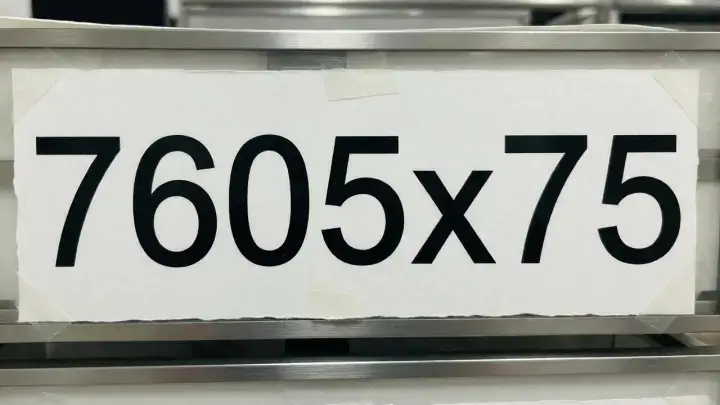
A five-digit number followed by a multiplication sign and another two-digit number does not look especially mysterious. Yet 7605×75 can send a reader in several different directions.
Is it a calculation? A measurement? A product reference? A technical code?
The answer depends on how the expression is being used. When the “x” represents multiplication, 7605×75 is a simple arithmetic problem, and the answer is 570,375. The calculation itself is straightforward. What makes the expression interesting is the way the same visual format can resemble other kinds of notation used in manufacturing, design, business documents, inventory systems, and technical writing.
That distinction is important because numbers rarely explain their own context.
Written as a mathematical expression, 7605 × 75 asks us to multiply 7,605 by 75. Written on a technical drawing, however, a similar format could mean “7,605 by 75” as dimensions. In a catalog, a pair of numbers might form a model or variant reference. Online, an unfamiliar numeric string can even be treated as a supposed code before anyone has established what it actually represents.
For 7605×75, the clearest established interpretation is mathematical. The arithmetic produces a precise result, and that result can be reached in several ways. Understanding those methods also reveals why multiplication is such an efficient operation: instead of adding 7,605 repeatedly 75 times, we can break the problem into manageable parts and arrive at the same total.
| Fact | Details |
|---|---|
| Expression | 7605 × 75 |
| First value | 7,605 |
| Second value | 75 |
| Operation | Multiplication |
| Exact result | 570,375 |
| Equivalent form | 7,605 × (3 × 25) |
| Another useful form | 7,605 × (75 + 0) |
| Mathematical category | Whole-number multiplication |
| Decimal result | 570,375.0 |
| Primary interpretation | Arithmetic expression when “×” means multiplication |
| Possible contextual ambiguity | “×” can also mean “by” in dimensional notation |
| Product or brand identity | No verified unique product identity established from the exact term |
| Technical-code status | No authoritative evidence establishes 7605×75 as one universal industrial standard |
What 7605×75 Actually Means
At its most direct level, 7605×75 means 7,605 multiplied by 75.
There is no hidden mathematical trick in the expression. The “x” is being used as a substitute for the multiplication symbol, while 7,605 and 75 are the two factors.
The calculation can be written as:
7,605 × 75 = 570,375
The result, 570,375, is called the product. The numbers being multiplied are called the factors.
That terminology becomes useful when discussing larger calculations because it separates the roles of the numbers. The first factor is 7,605. The second factor is 75. Together, they produce the product 570,375.
There is also an easy way to make the arithmetic less intimidating.
Instead of treating 75 as one large number, break it into 3 × 25:
7,605 × 75
becomes
7,605 × 3 × 25
First:
7,605 × 3 = 22,815
Then:
22,815 × 25 = 570,375
The answer is unchanged because multiplication is associative: the grouping of factors can change without changing the final product.
Another approach is to split 75 into 50 and 25:
7,605 × 50 = 380,250
and
7,605 × 25 = 190,125
Add them:
380,250 + 190,125 = 570,375
The second method is especially useful because multiplying by 50 and 25 can often be done mentally or with relatively little written work.
Why the Expression Looks More Complicated Than It Is
The visual size of a number can affect how people approach a calculation.
Seven thousand six hundred five may look difficult beside smaller classroom examples such as 24 × 6 or 125 × 8. But multiplication does not become conceptually different merely because the numbers have more digits.
The same principles apply.
The challenge is mainly one of organization.
For 7605 × 75, one traditional long-multiplication method looks like this:
7,605 × 5 = 38,025
Then the 7 in 75 represents seven tens, so:
7,605 × 70 = 532,350
Adding the two partial products gives:
38,025 + 532,350 = 570,375
This approach exposes an important feature of the calculation. The 75 is not just “75” in an abstract sense. It is made up of 70 and 5.
That means:
7,605 × 75 = (7,605 × 70) + (7,605 × 5)
Once that structure becomes visible, the calculation becomes much easier to check.
The Fastest Mental Routes to 570,375
Not every multiplication problem needs a formal written method.
For 7605×75, several mental shortcuts work well.
One particularly convenient observation is that 75 equals three-quarters of 100.
So:
7,605 × 75 = 7,605 × 100 × 0.75
First multiply by 100:
7,605 × 100 = 760,500
Then take three-quarters:
760,500 × 0.75 = 570,375
This is useful when working with percentages, pricing, discounts, quantities, or other situations where 75 percent appears naturally.
There is another elegant route:
75 = 3/4 × 100
Therefore:
7,605 × 75 = 7,605 × 100 × 3/4
Again, the result is:
570,375
These alternative methods are more than mathematical curiosities. They show why being comfortable with numbers is often about recognizing relationships rather than memorizing isolated procedures.
The Meaning Changes When the “X” Is Not Multiplication
This is where 7605×75 becomes more interesting.
The letter x and the multiplication sign × often look similar in ordinary typing, but context can change their meaning completely.
Suppose a document says:
7605 × 75 mm
That may describe a physical dimension rather than an arithmetic calculation.
In that situation, the expression could mean something is 7,605 millimeters by 75 millimeters. The reader should not automatically multiply the two numbers.
This distinction appears everywhere in technical and commercial writing.
A box might be described as 40 × 30 cm. A screen could be listed as 1920 × 1080 pixels. A sheet of material could have length and width written in the same form.
The “×” is functioning as “by.”
That is fundamentally different from multiplication.
Without units or surrounding information, a string such as 7605×75 can therefore be ambiguous. The expression itself does not always tell the reader what the author intended.
This is one reason clear documentation matters.
Why Context Matters More Than the Numbers
Imagine seeing “500 × 20” on a mathematics worksheet.
You would probably multiply the two values.
Now imagine seeing “500 × 20 mm” beside a drawing of a metal plate.
The interpretation changes.
The same characters can describe either an operation or a physical relationship between dimensions.
This is not a problem with the numbers. It is a problem of missing context.
The same principle applies to 7605×75.
If it appears in an equation, calculation, invoice, spreadsheet, or mathematics exercise, multiplication is a natural interpretation. If it appears beside units, drawings, dimensions, or product specifications, the “×” may mean “by.”
That is why assigning a single universal meaning to the string without seeing its original context would be unreliable.
Where a Calculation Like 7605×75 Can Appear
Large multiplication expressions occur in ordinary situations far more often than people might realize.
Consider inventory.
If a warehouse has 7,605 units of an item and a particular calculation calls for 75 such groups, multiplication provides the total quantity represented by those repeated groups.
The same principle applies to production planning. A factory may calculate the output generated by a fixed quantity produced over a certain number of production cycles. A retailer may calculate the total value of a quantity of goods when the per-unit price is known.
The expression can also appear in education, accounting, budgeting, statistics, engineering calculations, and spreadsheets.
The important point is that the arithmetic remains the same even though the surrounding story changes.
If the calculation genuinely represents 7,605 groups of 75, or 75 groups of 7,605, the product is 570,375.
7605×75 in Everyday Quantities
Multiplication is essentially a way of dealing with repetition.
Suppose someone has 75 identical groups, with 7,605 items in each group. Counting every item individually would be inefficient.
Instead:
7,605 × 75 = 570,375
The multiplication expresses the total immediately.
This is why multiplication is so deeply embedded in everyday life. It is used whenever the same quantity occurs repeatedly.
The numbers might represent objects, currency, measurements, units of time, production totals, or abstract values. The mathematical operation does not need to know what the numbers represent.
That meaning comes from the surrounding context.
The calculation simply establishes the relationship between them.
A Closer Look at the Number 7,605
The first factor deserves a little attention because its structure makes the calculation easier to understand.
The number 7,605 contains four place values:
- 7 thousands
- 6 hundreds
- 0 tens
- 5 ones
So it can be expressed as:
7,000 + 600 + 5
Multiplying each part by 75 gives:
7,000 × 75 = 525,000
600 × 75 = 45,000
5 × 75 = 375
Add them together:
525,000 + 45,000 + 375 = 570,375
This is another complete route to the same answer.
Notice something interesting about the zero in 7,605. It does not disappear conceptually. It indicates that the number contains no tens, even though the number itself contains thousands, hundreds, and ones.
Understanding place value makes large multiplication much less mysterious.
What Happens When 7605 Is Multiplied by 75?
The answer is not simply larger by a small amount.
Multiplying a number by 75 means taking it 75 times.
That is why 7,605 becomes 570,375.
A useful estimate provides a quick way to check whether that result makes sense.
7,605 is slightly above 7,500.
If we use 7,500 as a rough approximation:
7,500 × 75 = 562,500
The exact result, 570,375, is reasonably close to that estimate.
That tells us the answer is in the right general range.
This kind of estimation is valuable because arithmetic errors can sometimes produce answers that look perfectly reasonable at first glance. A quick estimate acts as a reality check.
If someone calculated 7605 × 75 and got 57,037.5, the estimate would immediately reveal something is wrong. The expected result should be around half a million, not fifty-seven thousand.
Why Verification Matters With Large Numbers
A calculation can be mathematically simple and still be entered incorrectly.
A misplaced zero, an incorrect digit, or a misunderstood symbol can change the result substantially.
For 7605×75, there are several easy verification methods.
One is decomposition:
7,605 × 70 = 532,350
7,605 × 5 = 38,025
Then:
532,350 + 38,025 = 570,375
Another is the 75-percent relationship.
Since 75 is three-quarters of 100:
7,605 × 100 = 760,500
Three-quarters of 760,500 is:
570,375
When two independent methods reach the same result, confidence in the calculation increases.
This habit is useful far beyond this particular expression.
The Difference Between Multiplication and Dimensions
The ambiguity surrounding 7605×75 deserves more attention because technical notation often places dimensions directly beside numbers.
Consider a hypothetical measurement written as:
7,605 × 75 mm
A reader might wonder whether the entire expression should be multiplied.
But if the notation belongs to a specification sheet, the author may intend “7,605 millimeters by 75 millimeters.”
The result of the multiplication would then be irrelevant to the intended meaning.
In other words, 570,375 is the correct mathematical product, but it is not necessarily the correct interpretation of every occurrence of the characters 7605×75.
That distinction is essential.
Online pages have sometimes described 7605×75 as a possible industrial or dimensional identifier, but those claims do not establish one universally recognized product or standard behind the exact expression.
The safer approach is to examine the source document before deciding what the notation means.
Why Numeric Codes Can Be Misleading
Numbers are often used as labels.
A warehouse may assign an internal item number. A software system may generate an identifier. A manufacturer may use a model number. A database may assign a record ID.
In those cases, the number itself does not necessarily describe the thing it identifies.
This is different from arithmetic.
If 7605 is an internal reference and 75 is a variant code, then 7605×75 may be a label rather than a multiplication expression.
There is no universal rule saying that two numbers separated by an “x” must be multiplied.
Context decides.
That is why a responsible interpretation should begin by asking where the expression came from.
A Note About Online Claims Surrounding 7605×75
Searching for an unusual expression can create another problem: repetition.
Several online pages currently describe 7605×75 in technical, industrial, or generalized coding terms. However, the pages do not establish a single authoritative definition, manufacturer, standard, or recognized product identity.
This matters because repeated online descriptions can create the appearance of consensus.
If several pages make the same claim, a reader might reasonably assume that the claim has been independently verified. But repeated wording does not necessarily mean independent evidence exists.
For an expression as simple as 7605×75, the strongest verifiable fact is the arithmetic itself.
The multiplication can be checked directly.
A supposed industrial meaning requires additional evidence.
That distinction keeps the explanation grounded.
The Role of 7605×75 in Learning Mathematics
A calculation such as 7605 × 75 can be useful as a teaching example because it sits between simple arithmetic and more advanced numerical reasoning.
Students can solve it using traditional long multiplication.
They can also use decomposition.
They can estimate the answer before calculating it.
They can compare multiple methods.
They can explore place value.
And they can learn how multiplication connects to real-world quantities.
This makes a seemingly ordinary expression surprisingly versatile.
A teacher could ask students to calculate the result and then explain why the answer is reasonable. Another exercise could ask them to find two different methods that reach the same product.
That second question is especially valuable because it shifts the emphasis from obtaining an answer to understanding the structure of the calculation.
The Importance of Place Value in 7605×75
Large-number multiplication becomes much easier when place value is understood.
Take the number 7,605.
The 7 is not simply “7.” It represents 7,000.
The 6 represents 600.
The 0 represents zero tens.
The 5 represents five ones.
When the number is multiplied by 75, every one of those place values participates in the calculation.
That is why the decomposition method works:
(7,000 + 600 + 5) × 75
Distribute the multiplication:
7,000 × 75 + 600 × 75 + 5 × 75
Then calculate:
525,000 + 45,000 + 375
And arrive at:
570,375
This is essentially the distributive property of multiplication in action.
Once this pattern is understood, many large calculations stop looking like isolated puzzles.
Could 7605×75 Be a Product Code?
It could theoretically be used as a product code by a particular organization, just as almost any number sequence could be assigned that role.
But “could be” is not the same as “is.”
No authoritative evidence establishes 7605×75 as a universally recognized product identifier.
That distinction prevents a common mistake in online research: taking a plausible interpretation and turning it into a factual identity.
A company could choose 7605×75 as an internal reference tomorrow. That would make it a product code in that particular company’s system. It would not automatically transform the expression into a universally recognized product.
For readers trying to identify an item, the manufacturer, surrounding documentation, units, labels, model family, or source document would be essential.
What Makes 7605×75 Interesting?
The expression is interesting precisely because it demonstrates how much context can change the interpretation of a very small piece of text.
Mathematically, the story is simple.
7605 × 75 = 570,375.
But outside mathematics, the same sequence can look like a measurement, identifier, or technical reference.
That is a useful lesson in reading numbers.
A number is not always a fact by itself. It can be a quantity, label, measurement, code, price, coordinate, version, or part of an equation.
The surrounding language tells us which role it is playing.
In that sense, 7605×75 is less about one mysterious number and more about how humans interpret compact information.
Common Mistakes When Reading 7605×75
One common mistake is assuming that every “x” means multiplication.
That is not true.
Another is assuming that every pair of numbers separated by “x” represents dimensions.
That is also not true.
A third mistake is searching for a supposed hidden identity before checking the simplest interpretation.
If the expression is being used mathematically, there may be no mystery to solve at all.
Another error is accepting an online explanation merely because several websites repeat it. As with any unusual numerical expression, the source and context matter more than the confidence of the wording.
Finally, people sometimes forget to check units.
“7605 × 75” and “7605 × 75 mm” do not necessarily communicate the same thing.
One is naturally read as arithmetic.
The other could be a dimensional specification.
How to Read an Unfamiliar Numeric Expression
When encountering a string like 7605×75, a sensible process is surprisingly simple.
First, identify where it appears.
A mathematics worksheet suggests one interpretation. A product label suggests another. A technical drawing suggests another.
Second, inspect the surrounding symbols.
Are there units such as mm, cm, kg, or pixels? Is there an equals sign? Is the expression part of a sentence? Does it appear beside a model number?
Third, determine whether the “x” is functioning as multiplication or “by.”
Fourth, look for an accompanying explanation.
Technical documents often define abbreviations and specifications elsewhere on the page.
Only after those questions have been answered should the expression be interpreted with confidence.
This approach works for far more than 7605×75.
Questions Readers Often Have About 7605×75
What is 7605×75?
When used as a mathematical expression, 7605×75 means 7,605 multiplied by 75. The exact result is 570,375.
What is the answer to 7605 × 75?
The answer is 570,375. One way to calculate it is to split 75 into 70 and 5: 7,605 × 70 equals 532,350, while 7,605 × 5 equals 38,025. Adding those products gives 570,375.
Is 7605×75 always a multiplication problem?
No. The context determines the meaning. In mathematics, the “x” normally indicates multiplication. In technical or design contexts, “×” can mean “by,” describing two dimensions rather than asking for a product.
Can 7605×75 describe dimensions?
It can potentially be used in dimensional notation if the original document defines the two values as measurements. However, the expression by itself does not establish any particular physical dimensions or units.
Is 7605×75 a known product or brand?
There is no verified evidence establishing the exact expression as a universally recognized product or brand. Some online pages associate it with technical or industrial uses, but those claims do not establish one authoritative identity.
Why might someone search for 7605×75?
A person may search the expression because they encountered it in a document, calculation, product listing, technical reference, or other context and want to determine whether it is arithmetic, a measurement, or an identifier.
How can I calculate 7605×75 without a calculator?
A convenient method is to split 75 into 50 and 25. Calculate 7,605 × 50 = 380,250 and 7,605 × 25 = 190,125. Adding the two gives 570,375.
Is there an easier mental-math method?
Yes. Because 75 is three-quarters of 100, multiply 7,605 by 100 to get 760,500 and then take three-quarters of that amount. The result is 570,375.
What should I do if I found 7605×75 on a technical document?
Look at the surrounding information before assuming it is multiplication. Check for units, product names, model numbers, diagrams, labels, or explanatory notes. If the expression appears as a dimension, the “x” may mean “by” rather than multiplication.
Why a Simple Expression Can Tell a Bigger Story
7605×75 does not need a celebrity, company, invention, or elaborate origin story to be worth examining.
Its real value lies in the distinction between calculation and context.
As arithmetic, it is exact. Seven thousand six hundred five multiplied by seventy-five equals 570,375. The result can be demonstrated through long multiplication, decomposition, place value, estimation, or percentage-based reasoning.
Outside arithmetic, however, the same visual form can mean something else. A multiplication symbol can become a dimensional separator. A number can become a product identifier. A compact expression can become an internal reference.
That is why context remains the deciding factor.
For readers who regularly encounter unusual numbers online, the lesson is straightforward: do not assume that appearance determines meaning. Check the surrounding material. Look for units. Identify the source. Separate a confirmed interpretation from a plausible one.
The expression 7605×75 is a good reminder that sometimes the simplest answer is also the most useful one.
When the “x” means multiplication, the answer is clear:
570,375.
Everything beyond that requires context.
The Number Is Simple; Reading It Correctly Is the Real Skill
There is a tendency to think that understanding numbers means knowing how to calculate them. In practice, another skill matters just as much: knowing what the numbers are being used to represent.
That distinction turns 7605×75 into a small but useful case study.
The arithmetic is settled. The product is 570,375.
What remains open is the meaning of the notation whenever it appears outside a mathematical setting.
That is not a flaw. It is how written numerical language works.
A measurement, a calculation, and an identifier can share the same digits while communicating completely different information. The reader’s job is not to guess. It is to locate the context that gives those digits their meaning.
And that may be the most useful thing to take away from 7605×75: numbers become understandable not merely when we calculate them, but when we know what they are telling us.
For More Visits: Dailymagazine