

 English





















































BacktoFrontShow Pricing: Plans, Costs & Value

Searching for backtofrontshow pricing is not quite as simple as looking for a single subscription number. The current BacktoFrontShow offering is positioned around podcast analytics, audience intelligence, engagement tracking, and business-focused reporting, which puts it in a very different category from the inexpensive tools many independent podcasters use.
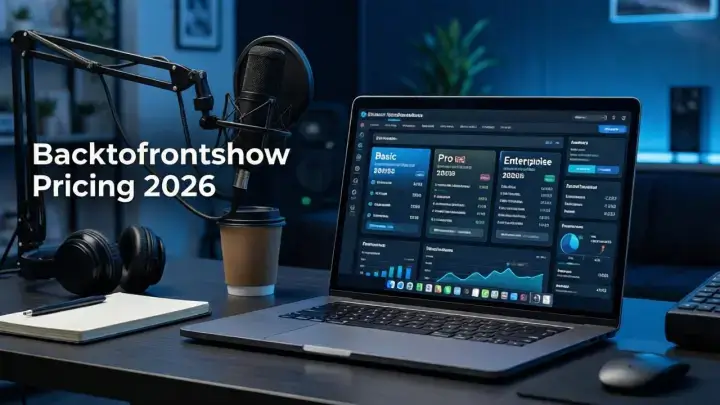
The publicly displayed pricing presents three levels: Basic, Pro, and Enterprise. The Basic plan is listed at $1,200 per month, the Pro plan at $3,600 per month, while Enterprise pricing requires direct contact. Those figures immediately raise a more useful question than simply asking how much the service costs: what does a podcast business actually receive in return for paying that much each month?
That distinction matters. A creator who records a small personal podcast may have very different needs from a media company managing several shows, a marketing department using podcasts to generate business, or an organization that needs detailed audience intelligence and custom reporting.
This guide takes a practical look at BacktoFrontShow pricing, the differences between its plans, the type of operation each tier may suit, and the questions worth asking before committing to a premium analytics platform.
BacktoFrontShow at a Glance
Before getting into the details, it helps to understand what the current offering is designed around. BacktoFrontShow presents itself as a podcast analytics platform rather than simply a place to upload audio files.
The emphasis is on understanding audiences and measuring behavior. Depending on the plan, the advertised capabilities cover areas such as listener demographics, playback locations, engagement activity, listening behavior, device information, reporting, integrations, and business-level support.
That positioning explains why its pricing is considerably higher than the entry-level subscriptions commonly associated with basic podcasting software.
| FactDetails | Information |
|---|---|
| Product Name | BacktoFrontShow |
| Product Category | Podcast analytics and audience intelligence platform |
| Core Use | Podcast audience analysis, engagement tracking, and reporting |
| Public Pricing Tiers | Basic, Pro, and Enterprise |
| Basic Plan | $1,200 per month |
| Pro Plan | $3,600 per month |
| Enterprise Plan | Custom pricing |
| Primary Audience | Professional podcasters, media teams, and organizations |
| Key Analytics Areas | Demographics, listening behavior, engagement, playback locations, and related audience data |
| Advanced Capabilities | API integration, custom reporting, white-labeling, account support, and specialized features |
| Billing Perspective | Publicly displayed prices are monthly figures |
| Main Buying Consideration | Whether advanced analytics justify the monthly investment |
What Is Behind BacktoFrontShow Pricing?
The easiest way to misunderstand a premium analytics platform is to compare its price with a completely different type of product.
Podcast hosting, recording, editing, distribution, and analytics are separate functions. Some inexpensive platforms focus primarily on helping creators publish episodes. BacktoFrontShow’s current positioning is much more centered on understanding what happens after an audience encounters a podcast.
That difference changes the economics.
A small creator might be satisfied knowing that an episode received a certain number of downloads. A professional organization may need to know considerably more. It could want to understand who is listening, where listening occurs, how audiences interact with episodes, which content attracts stronger engagement, and how those patterns can be translated into useful business information.
This is where BacktoFrontShow pricing becomes easier to understand.
The service is not being presented as a basic podcast subscription for someone experimenting with their first microphone. Its published plans suggest a product intended for users who place meaningful commercial or operational value on audience information.
That does not automatically mean the platform is worth its price for every professional podcast. It means the value calculation needs to go beyond comparing monthly subscription figures.
For a serious media organization, analytics can influence content decisions, audience development, sponsorship discussions, marketing campaigns, and reporting. For a hobbyist, those same capabilities may be unnecessary.
The right question is therefore not simply, “Is $1,200 expensive?”
The better question is, “Will the information and capabilities included at that price materially improve the way this podcast operation works?”
The Basic Plan: What $1,200 a Month Represents
The Basic plan is publicly listed at $1,200 per month, making it the entry point into the current BacktoFrontShow pricing structure.
At first glance, calling a $1,200 monthly subscription “Basic” may seem surprising. The word basic, however, is relative to the other tiers within the same platform. It does not necessarily mean a simple or bare-bones product.
The advertised Basic capabilities include comprehensive analytics, listener demographic information, playback-location insights, user engagement monitoring, customer support, and data-security features.
Those features point toward an audience-analysis workflow rather than ordinary podcast hosting.
Audience demographics
Understanding audience demographics can help a professional podcast team move beyond raw traffic numbers.
A download figure tells you that content was accessed. Demographic information can provide additional context around who that audience represents.
For businesses, this distinction can matter when deciding what topics to pursue, how to communicate with listeners, or how closely a podcast audience aligns with a broader customer profile.
However, the usefulness of demographic data depends on how a company intends to use it. Data is not automatically valuable simply because it exists. A team should have a clear reporting process and specific questions it wants the analytics to answer.
Playback-location insights
Location-related information can add another layer to audience understanding.
A podcast with listeners distributed across different markets may need to know where attention is concentrated. That can become relevant when planning campaigns, evaluating geographic reach, or deciding where future promotional efforts should focus.
Again, the value is contextual. A creator with a highly localized audience may not need sophisticated geographic analysis, while a large media organization could consider it an important part of audience intelligence.
Engagement monitoring
The Basic plan also advertises monitoring for interactions such as likes, shares, and comments.
This can help a podcast team distinguish passive consumption from visible audience participation.
An episode that receives strong listening activity but little visible interaction may tell a different story from one that generates substantial discussion and sharing. Looking at these signals together can provide a more complete picture of how audiences respond.
Support and security
The Basic plan also includes advertised customer support and data-security features.
For a professional operation, support can matter because analytics problems are not always convenient to postpone. If reports are used in regular business processes, access to assistance becomes part of the practical value of a platform.
Security is similarly more important when a company is handling business-sensitive information and integrating analytics into a wider technology environment.
Who Is the Basic Plan Really For?
The $1,200 monthly price immediately narrows the potential audience.
It is difficult to justify a premium analytics subscription simply because a podcast exists. A professional team should have a business reason for needing the information.
The Basic plan may make more sense for an established podcast brand, media operation, company podcast, or organization that needs more sophisticated audience reporting than basic podcast statistics can provide.
It may also be relevant to teams where multiple people need access to structured analytics rather than relying on manually assembled reports.
For a solo creator running a podcast as a personal project, the economics may be very different.
If the podcast generates little direct or indirect business value, paying $1,200 every month for analytics could represent an unnecessary expense. On the other hand, if audience insights influence advertising, sponsorships, sales, content strategy, or customer acquisition, the same price could be evaluated from a very different perspective.
This is why BacktoFrontShow pricing should always be considered alongside the purpose of the podcast.
The Pro Plan: $3,600 a Month
The next level is the Pro plan, listed at $3,600 per month.
That is three times the published monthly price of Basic, so the difference between the two plans deserves careful attention.
The Pro tier adds more advanced analytics and capabilities, including areas such as listening behavior, additional audience information, engagement analysis, and API integration.
The appeal of Pro is less about having “more data” in the abstract and more about what an organization can do with that data.
Listening behavior
Listening behavior can provide deeper context than simple audience counts.
A professional podcast team may want to understand how audiences interact with episodes, where attention is strongest, and how different pieces of content perform.
These insights can help teams think about episode structure, subject selection, publishing decisions, and audience retention.
The practical value comes from turning observations into decisions.
If a team collects extensive analytics but never changes its editorial or marketing strategy, the additional data may have little financial impact.
Real-time and advanced reporting
More advanced analytics can also be useful for organizations that require current information rather than occasional manual reporting.
Real-time or frequently updated information can be valuable during campaigns, launches, promotional periods, or major content releases.
A large media team may also need customized reporting for different departments. Marketing may care about engagement. Editorial teams may care about listening behavior. Executives may want a concise performance overview.
A flexible reporting system can reduce the need to manually assemble those different views.
API integration
API integration is one of the clearest signs that the Pro plan is aimed at organizations with more sophisticated technical requirements.
An API can allow information from one system to interact with another, potentially making it easier to connect analytics with an organization’s broader technology environment.
For a technically simple podcast, that may not matter at all.
For a company with internal dashboards, data systems, reporting tools, or other software, integration can become considerably more valuable.
The important point is that an API should not be treated as a valuable feature merely because the term sounds advanced. The real question is whether the organization has a practical workflow that benefits from connecting systems.
Enterprise Pricing: Why There Is No Public Number
The Enterprise plan does not display a standard monthly price. Instead, businesses are directed toward custom pricing.
That approach is common for services aimed at organizations with requirements that can vary substantially from customer to customer.
An enterprise customer might need different levels of support, reporting, integration, branding, onboarding, training, or data handling. A fixed public subscription could therefore be too restrictive.
The Enterprise offering advertises a broader collection of capabilities, including premium templates, priority feature requests, dedicated account management, white-labeling options, advanced user training, monthly analytics webinars, and custom onboarding.
These features change the buying conversation.
A company considering Enterprise should not focus solely on getting the lowest possible quote. It should first define exactly what it needs.
A custom plan becomes much easier to evaluate when the buyer has a written list of requirements.
Basic vs. Pro vs. Enterprise
The three plans are aimed at noticeably different levels of need.
| Plan | Published Price | General Position |
|---|---|---|
| Basic | $1,200/month | Professional podcast analytics |
| Pro | $3,600/month | Advanced analytics and integration |
| Enterprise | Custom | Large or specialized organizational requirements |
Basic is the starting point for teams that need professional audience analytics.
Pro makes more sense when deeper behavioral information and technical integration become important.
Enterprise is designed around customization and organizational support rather than a fixed package.
The difference is therefore not simply “cheap, medium, expensive.” Each tier represents a different level of operational complexity.
What Does BacktoFrontShow Actually Help a Podcast Team Understand?
The strongest argument for a platform like BacktoFrontShow is not the dashboard itself. It is the possibility of making better decisions from audience information.
Consider a podcast team planning its next season.
Without detailed analytics, decisions might be driven primarily by intuition, social comments, or download totals.
With more extensive audience information, the team could potentially look at several signals together.
Which subjects attract attention?
Where are listeners located?
How does engagement vary between episodes?
What kinds of episodes appear to generate stronger interaction?
How does audience behavior change over time?
These questions do not guarantee better decisions, but they can make the decision-making process more informed.
That is the underlying logic behind premium podcast analytics.
The software is useful when the information changes what the organization does.
The Real Cost Is More Than the Monthly Subscription
When evaluating BacktoFrontShow pricing, it is easy to focus entirely on the $1,200 and $3,600 figures.
A more complete financial evaluation should consider the total cost of using the platform.
For example, a company should ask whether implementation requires internal technical resources. It should also consider who will interpret the analytics and how often reports will be reviewed.
If nobody on the team has responsibility for turning analytics into decisions, even sophisticated software can become an expensive dashboard that receives little attention.
There is also the question of integration.
If a business wants to connect analytics with internal systems, it should understand what technical work will be necessary and whether that work is included in the commercial arrangement.
Enterprise buyers should also clarify onboarding, support expectations, account management, customization, and any terms associated with additional services.
None of these considerations necessarily represent hidden fees. They are simply part of evaluating the complete cost of adopting professional software.
For broader publishing and media insights, readers can also explore digital media resources when evaluating how analytics fits into a larger content operation.
How to Decide Whether $1,200 a Month Makes Sense
The simplest approach is to start with measurable outcomes.
Suppose a company spends $1,200 every month on analytics. The platform therefore needs to contribute to enough value to justify that expenditure.
That value does not necessarily have to come directly from podcast advertising.
A business podcast might generate value by supporting sales conversations, strengthening brand authority, attracting potential customers, improving retention, supporting marketing campaigns, or helping a company understand its audience.
The relevant calculation depends on the business model.
For example, if a podcast is a major part of a company’s customer-acquisition strategy, better audience intelligence may have meaningful financial value.
If the podcast exists primarily as a passion project with no commercial purpose, the same subscription becomes much harder to justify.
This is why there is no universal answer to the question, “Is BacktoFrontShow worth it?”
The price is fixed within the published Basic and Pro tiers, but the value is not.
When Pro May Be More Practical Than Basic
The jump from $1,200 to $3,600 per month is significant.
A business should therefore avoid upgrading simply because Pro has more features.
The additional cost needs a purpose.
Pro may become more attractive when a podcast operation has a larger audience, more complex reporting requirements, multiple internal stakeholders, or a genuine need for API integration.
Imagine a media organization where podcast analytics are connected to other internal systems. In that environment, integration could save time and create a more centralized reporting process.
Now imagine a single podcast creator who checks analytics once every few weeks.
The same Pro features would probably be difficult to justify.
The best plan is not necessarily the one with the most capabilities. It is the one whose capabilities are actually used.
Enterprise Is About Customization as Much as Analytics
Enterprise pricing deserves a slightly different way of thinking.
Once a company reaches enterprise requirements, the conversation usually becomes less about selecting a standard package and more about defining a working relationship.
Dedicated account management can matter when several teams depend on the platform.
White-labeling can matter when analytics need to appear under a company’s own branding.
Custom onboarding can matter when multiple users need to understand the system.
Priority feature requests can matter when a business has specialized operational requirements.
Training can also become useful when the organization wants analytics to be adopted across departments rather than left to one specialist.
For that reason, an Enterprise quote should be evaluated as a package of technology and service rather than simply as a more expensive version of Basic.
Questions to Ask Before Paying
Anyone considering BacktoFrontShow should clarify the commercial details before making a commitment.
The most useful questions are practical rather than promotional.
Is the published price still current?
Pricing can change, so the displayed figure should be confirmed before signing an agreement.
What exactly is included in the selected tier?
A feature listed on a general product page may not always answer every implementation question. Ask for a clear explanation of what is included.
Are there usage limits?
A buyer should understand whether analytics, users, reports, integrations, or data access have limitations.
What support is included?
Support can mean different things to different organizations. Ask how support works and what level of assistance is available.
How does API access work?
Organizations considering Pro or Enterprise should understand available integration options before building an internal workflow around them.
Is onboarding included?
This can be particularly important for larger teams.
Are there contractual commitments?
A buyer should understand billing frequency, cancellation conditions, renewal terms, and any minimum commitment before agreeing to a subscription.
Can the platform support the existing podcast setup?
Analytics are only useful if they can work with the podcast infrastructure and data sources the organization already uses.
Common Mistakes When Researching BacktoFrontShow Pricing
The name can produce confusion because people may encounter pages describing different products, older references, or unrelated services.
That makes one mistake particularly easy: assuming every result using the BacktoFrontShow name refers to exactly the same offering.
Another mistake is treating an annualized calculation as an official annual price.
For example, multiplying $1,200 by 12 gives $14,400. That is simple arithmetic, but it does not prove that the company sells an annual package for exactly $14,400 or that an annual discount is unavailable.
The same applies to the Pro plan. Multiplying $3,600 by 12 produces $43,200, but that should be understood as a straightforward annual equivalent of the displayed monthly figure, not necessarily a published annual contract price.
A third mistake is assuming the most expensive plan is automatically the best choice.
Premium software should be matched to actual requirements.
Finally, buyers should avoid judging analytics tools purely by the number of features listed on a page. A smaller collection of useful features can be more valuable than a large collection that a team never uses.
Why Audience Analytics Can Matter More Than Download Counts
Podcasting has always produced an abundance of numbers.
Downloads, plays, subscribers, followers, comments, shares, and other measurements can all tell part of the story.
But no individual number can explain the entire relationship between a podcast and its audience.
A show can have a large audience without generating meaningful business results. Another show can have a smaller but highly relevant audience that is far more valuable to the organization behind it.
This is why audience intelligence can become more useful as a podcast matures.
A professional team may want to understand not just how many people are listening but how those listeners behave.
The distinction is subtle but important.
Counting audiences tells you about scale.
Understanding audiences tells you more about composition and behavior.
BacktoFrontShow’s current positioning is built around the second idea.
How BacktoFrontShow Fits a Larger Content Strategy
A podcast rarely exists completely on its own.
An episode can generate written content, social posts, newsletters, video clips, discussions, interviews, promotional campaigns, and other forms of media.
Analytics can potentially help a team decide where to place additional effort.
If certain topics consistently attract strong engagement, they may deserve greater attention.
If an episode performs well in one market but poorly in another, promotional decisions may change.
If audience behavior reveals a mismatch between the content being produced and the audience being reached, the editorial strategy may need adjustment.
This broader perspective makes analytics more interesting than a simple reporting exercise.
The goal is not to collect numbers.
The goal is to use information to improve the entire content operation.
Readers interested in the wider world of publishing, online media, and content trends can also browse magazine and media coverage for additional context around digital publishing.
Is BacktoFrontShow Worth the Investment?
There is no universal yes or no.
For a hobby podcaster, the answer is likely to be very different from the answer for a professional media company.
The published $1,200 Basic price places BacktoFrontShow firmly in a premium category. The $3,600 Pro tier moves further into professional and enterprise-level spending, while Enterprise is designed for custom requirements.
That pricing can make sense when analytics are connected to meaningful commercial decisions.
A company spending heavily on content, marketing, sponsorships, or audience development may benefit from more sophisticated reporting than basic podcast statistics provide.
But a platform cannot create value simply by existing.
The team using it must know what questions it wants to answer, who will interpret the information, and what decisions will change as a result.
That is the central test.
If the analytics influence strategy, the subscription can become an operating tool.
If the analytics simply sit unused, even a lower-priced service would be difficult to justify.
BacktoFrontShow Pricing and the Importance of Context
One of the most useful lessons from researching backtofrontshow pricing is that price cannot be separated from purpose.
A $1,200 monthly subscription sounds expensive when compared with basic creator software.
It can look very different when compared with the cost of running a professional media operation that depends on detailed audience reporting.
Likewise, $3,600 per month may seem excessive for one independent creator while potentially being a manageable technology expense for a company with multiple shows, departments, campaigns, and revenue streams.
The right comparison is therefore not simply between BacktoFrontShow and the cheapest podcast platform available.
The more meaningful comparison is between the platform’s cost and the problem the buyer is trying to solve.
If the problem is simply hosting audio files, a premium analytics platform may be unnecessary.
If the problem is understanding audience behavior across a serious podcast operation, the evaluation becomes much more interesting.
What the Pricing Tells You About the Product
Pricing itself can reveal something about how a company positions its product.
The current structure suggests that BacktoFrontShow is not trying to compete primarily as an entry-level podcast tool.
The Basic plan already sits at a professional price point.
The Pro plan increases the investment substantially while adding more advanced capabilities.
Enterprise moves toward customized commercial arrangements.
That progression is consistent with a product designed around organizations that place a high value on analytics, reporting, integration, and support.
It also means potential customers should approach the service differently from a casual software subscription.
A business spending thousands of dollars per month should conduct a proper needs assessment.
Who will use the platform?
What information is required?
Which systems need integration?
What reports need to be generated?
What decisions will the data influence?
How will success be measured?
Those questions are more valuable than simply asking which plan has the longest feature list.
Frequently Asked Questions About BacktoFrontShow Pricing
How much does BacktoFrontShow cost?
The publicly displayed pricing currently lists the Basic plan at $1,200 per month and the Pro plan at $3,600 per month. The Enterprise plan uses custom pricing, so businesses interested in that tier need to discuss their requirements directly.
These figures should be treated as monthly published prices rather than assumptions about annual contracts, discounts, or additional commercial terms.
What is the cheapest BacktoFrontShow plan?
The Basic plan is the lowest publicly listed tier at $1,200 per month.
Although it is called Basic, it is positioned as a professional analytics package rather than a basic podcast-hosting subscription. Its advertised capabilities include audience demographics, playback-location analysis, engagement monitoring, support, and security-related features.
What does the BacktoFrontShow Pro plan cost?
The Pro plan is publicly listed at $3,600 per month.
It is intended for users requiring more advanced analytics and functionality. Advertised capabilities include deeper listening and audience analysis as well as API integration and other advanced features.
The higher price makes it most relevant to organizations that can make practical use of those capabilities.
Is there an Enterprise BacktoFrontShow price?
There is no standard public Enterprise figure displayed with the Basic and Pro prices.
Enterprise uses custom pricing. That means the final cost can depend on the organization’s requirements and the package agreed with the provider.
Businesses considering Enterprise should request a detailed commercial proposal that clearly explains included features, support, integrations, onboarding, and other terms.
Is BacktoFrontShow a podcast hosting platform?
The current positioning focuses primarily on podcast analytics and audience intelligence rather than presenting the service as a conventional podcast hosting solution.
Anyone considering it should confirm exactly which parts of their existing podcast workflow it will replace and which services they will continue using separately.
Who should consider BacktoFrontShow?
BacktoFrontShow appears most relevant to professional podcasters, media teams, businesses, agencies, and organizations that place significant value on detailed audience analytics.
The pricing makes it less naturally suited to casual creators who simply want to publish a podcast and monitor basic performance.
Is the $1,200 Basic plan worth it?
That depends entirely on how the organization uses the information.
If audience analytics influence important marketing, editorial, sponsorship, sales, or business decisions, the subscription may be worth evaluating seriously.
If the podcast is a hobby and detailed analytics are rarely reviewed, the monthly cost may be difficult to justify.
What is the annual equivalent of the Basic plan?
At the displayed monthly rate, twelve months of Basic would mathematically equal $14,400.
That is an annualized calculation based on the monthly price, not confirmation of an official annual billing package or discount.
What is the annual equivalent of Pro?
At $3,600 per month, twelve months would mathematically equal $43,200.
Again, this is simply the monthly figure multiplied by twelve. It should not be interpreted as confirmation that the provider offers a fixed annual contract at exactly that amount.
Should a small podcast choose Basic or Pro?
A small podcast should not automatically choose either plan simply because both are available.
The better starting point is to determine whether the podcast genuinely requires professional analytics, what information is needed, and how frequently it will be used.
If advanced integrations and deeper analytics are unnecessary, paying for Pro would make little sense. If the organization has technical and reporting requirements that exceed Basic, Pro may be more appropriate.
Final Thoughts on BacktoFrontShow Pricing
The most useful way to understand backtofrontshow pricing is to stop treating it as a simple subscription comparison.
The current public structure is straightforward on the surface: Basic is $1,200 per month, Pro is $3,600 per month, and Enterprise is custom-priced. What requires more thought is deciding whether the capabilities behind those prices solve a meaningful problem for the buyer.
BacktoFrontShow is positioned around podcast analytics, audience behavior, engagement, reporting, and more advanced organizational needs. That makes its value highly dependent on the scale and purpose of the podcast operation using it.
For a casual creator, the pricing may be difficult to justify.
For a professional team that relies heavily on audience intelligence, the calculation can be very different.
The smartest approach is to begin with business requirements rather than plan names. Identify what information is needed, how it will be used, who will manage it, which integrations matter, and what measurable outcome the platform is expected to support.
Once those questions are answered, the price becomes easier to evaluate.
The real issue is not whether BacktoFrontShow is expensive in isolation. It is whether the information, analytics, integrations, support, and reporting capabilities provide enough practical value to justify the investment for the specific organization considering them.
For More Visits: Dailymagazine