
 English





































The Psychology of Cleanliness Mrshomegen Explained

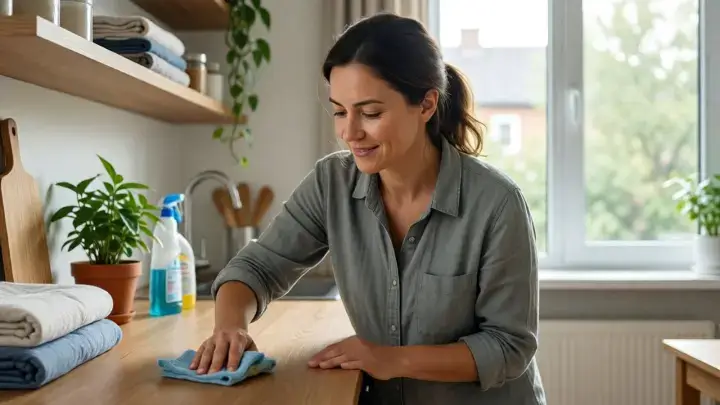
A kitchen counter covered in yesterday’s mail, a chair carrying three days of clothes, or a hallway slowly disappearing beneath shoes can look like nothing more than an ordinary household problem. Yet the experience of living around those things can be surprisingly complicated. A room does not need to be filthy to feel exhausting. Sometimes the visual presence of unfinished tasks is enough.
That observation sits at the heart of the psychology of cleanliness mrshomegen, a subject that connects the practical world of household maintenance with the less visible world of attention, stress, control, habit, and emotional well-being.
Mrs Home Gen presents itself as a home-and-lifestyle platform built around interior design, DIY projects, gardening, sustainable living, and practical household guidance. Its founder page identifies Zayric Zorvane as the founder, while the site’s broader mission describes the home as something more than a physical structure: a living environment shaped by care, creativity, and everyday routines.
The site’s article specifically devoted to the psychology of cleanliness argues that disorder can affect the way people experience their surroundings and recommends small, repeatable systems rather than perfectionism. It discusses visual clutter, stress, attention, routines, organization, and the feeling of control that can come from completing tangible household tasks.
Those ideas are not all equally established by science. Some are practical observations made by the site; others have parallels in psychological research. That distinction is important because cleanliness can mean several different things. A visually tidy room, a hygienically safe surface, an organized home, and an absence of compulsive cleaning are not the same condition.
The most interesting question, then, is not simply why people like clean homes.
It is why the state of a home can sometimes feel like a statement about the state of the person living inside it.
Quick Bio
| Fact | Details |
|---|---|
| Full Name | Zayric Zorvane is the person identified by Mrs Home Gen as its founder and the byline used on the site’s psychology-of-cleanliness article. |
| Date of Birth | A reliable date of birth is not established in the available Mrs Home Gen material; the site’s public biography focuses on professional work rather than birth details. |
| Birthplace | No independently established birthplace is provided in the available biographical material. Mrs Home Gen identifies its founder and operations with Franklin, Massachusetts. |
| Nationality | The available public biography does not reliably establish Zayric Zorvane’s nationality. |
| Profession | Founder and home/lifestyle content creator associated with Mrs Home Gen; the platform focuses on home improvement, interior design, DIY, gardening, sustainability, and creative inspiration. |
| Known For | Founding Mrs Home Gen and publishing practical home-and-lifestyle guidance, including material examining the psychological relationship between cleanliness, clutter, and well-being. |
| Years Active | The available public record does not establish a complete professional timeline. The current Mrs Home Gen website documents ongoing activity and identifies Zayric Zorvane as founder. |
| Net Worth | No credible financial disclosure or independently verified estimate was found. It would be misleading to assign a figure based on website ownership or online activity alone. |
| Marital Status | Not reliably established by the available public biographical material. |
| Spouse | No reliably established spouse is identified in the available sources. |
| Children | No reliably established information about children is provided in the available public biography. |
| Notable Works | Mrs Home Gen articles including “The Psychology of Cleanliness Mrshomegen,” “How a Clean Space Affect Your Mood Mrshomegen,” and practical home-improvement and cleaning guides. |
| Major Achievements | The clearest documented achievement is the creation and development of Mrs Home Gen as a home-and-lifestyle platform. Claims about audience satisfaction or adoption rates appear on the site’s own material and are not independently verified. |
The Unusual Idea Behind a Clean Counter
Cleanliness is usually discussed as a practical matter.
There is dirt, so you remove it.
There is clutter, so you organize it.
There is dust, so you wipe it away.
But the Mrs Home Gen treatment takes the subject somewhere more psychological. Its central argument is that the physical condition of a living space can influence the experience of the person occupying it. The site’s article frames clutter not simply as an aesthetic problem but as something that can contribute to feelings of unfinished business, distraction, and reduced control.
That proposition has a legitimate research background, although it needs to be stated carefully.
A 2010 study by Darby Saxbe and Rena Repetti examined descriptions of home environments from 60 dual-income spouses and compared perceptions of stressful or restorative homes with later patterns of mood and cortisol. The researchers found associations between more stressful descriptions of the home and less favorable daily cortisol patterns and mood among the wives in the study.
The study does not prove that every messy room causes stress.
It does, however, support a broader idea: the home environment can be psychologically meaningful.
That distinction matters.
There is no universal scientific rule saying that every person who leaves dishes in a sink will experience anxiety. Nor does a perfectly organized home automatically produce happiness. Human beings differ enormously in their tolerance for disorder, their living circumstances, their responsibilities, and their relationship with possessions.
The psychology of cleanliness is therefore less about a magical formula and more about interaction.
The person affects the environment.
The environment affects the person.
And habits develop between the two.
Zayric Zorvane and the Mrs Home Gen Philosophy
The public identity of Zayric Zorvane is closely tied to Mrs Home Gen itself.
The site’s founder page describes Zorvane as the visionary founder of a lifestyle and home-improvement brand concerned with beautiful, functional, and sustainable living spaces. Its wider description includes interior design, DIY creativity, modern home trends, gardening, and eco-conscious solutions.
The site’s “Our Story” page presents a similar philosophy, describing homes as environments shaped by care, creativity, and resilience. It emphasizes a human-centered approach and rejects a one-size-fits-all philosophy.
That last point is particularly relevant to cleanliness.
A psychologically useful cleaning routine cannot be separated from the life of the person using it.
A household with young children operates differently from a single-person apartment.
A person working from home experiences a desk differently from someone who leaves for an office every morning.
Someone living with pets has different cleaning demands.
A person with limited mobility may need completely different systems.
Even the definition of “clean enough” changes from household to household.
The Mrs Home Gen material repeatedly leans toward manageable systems rather than dramatic transformations. Its general home advice describes practical improvements that can be incorporated into ordinary life rather than requiring a perfect redesign.
That philosophy gives the cleanliness discussion a useful foundation: the objective is not to create a showroom.
It is to make the home easier to live in.
When Clutter Becomes a Cognitive Problem
The human visual system is designed to process enormous amounts of information.
That is useful when crossing a street, navigating a crowded building, or finding a familiar face.
It can become tiring when every surface in a room contains competing objects.
Research discussed by Princeton psychology professor Sabine Kastner has emphasized the way visual distractions can compete with attention. Princeton’s account of her work describes visual clutter as something that can interfere with attention and tire cognitive functions over time.
This provides a useful scientific context for one of the most intuitive aspects of the Mrs Home Gen approach.
Imagine sitting at a desk.
On one side is a laptop.
Beside it are three receipts.
Under the receipts is an unopened envelope.
A cup sits near the keyboard.
There is a charging cable running across the desk.
A stack of books leans against the wall.
None of these objects is individually important.
Together, however, they create a visual field filled with unfinished possibilities.
The brain does not necessarily announce, “I am now distracted by clutter.”
The effect can be subtler.
You notice the envelope.
You remember that you should answer it.
You see the cup and remember that it needs washing.
You notice the books and think about the project you have postponed.
The room becomes a collection of reminders.
This is one reason the psychology of cleanliness is better understood as a question of environmental design than simply scrubbing.
The “Unfinished Business” Effect
One of the strongest themes in the Mrs Home Gen article is the idea that visible disorder can represent unfinished work. Mail still needs sorting. Clothes still need folding. Dishes still need washing. Items still need homes.
This is not necessarily the same thing as a formal psychological effect with one universally accepted name.
But it describes a familiar human experience.
A task that remains visible remains easier to remember.
That can be helpful when the task is genuinely important.
It can also become exhausting when dozens of small tasks remain permanently visible.
The result is a peculiar feature of domestic life: the home can function as both shelter and to-do list.
A kitchen counter can remind you to clean.
A laundry basket can remind you to wash.
A desk can remind you about work.
A pile of paperwork can remind you about administration.
A cluttered bedroom can make rest feel less complete because the environment still appears to demand attention.
The solution is not necessarily to remove every object.
It is to distinguish between useful visibility and unnecessary visual noise.
Why Small Cleaning Tasks Can Feel Surprisingly Satisfying
Cleaning has a characteristic that many abstract problems lack: immediate feedback.
If a person worries about a complicated professional problem, there may be no visible sign of progress at the end of an hour.
Cleaning is different.
A dusty shelf becomes clean.
A full trash bag becomes empty.
A crowded table becomes usable.
A pile of laundry becomes folded clothing.
The transformation is visible.
The 2023 research published in Social Psychological and Personality Science offers an especially interesting perspective. In preregistered experiments involving more than 3,000 participants across the United Kingdom, United States, and Canada, researchers found evidence that actual cleaning and even simulated cleaning could attenuate some psychological and physiological responses to stress. The researchers proposed that cleaning may have coping functions extending beyond contamination or disease.
That does not mean cleaning is a universal treatment for stress.
It does suggest that the physical act of cleaning can have psychological consequences beyond making an object look better.
There is something psychologically distinctive about doing a task whose result can be seen.
You act.
The environment changes.
You can verify the change.
That sequence can produce a sense of agency.
Control Is One of the Hidden Themes
The word “control” appears repeatedly in discussions about the psychological benefits of cleaning.
That is not accidental.
Modern life contains many situations that cannot be immediately fixed. A person cannot always control work demands, financial pressures, relationships, traffic, uncertainty, or other people’s behavior.
But a kitchen counter is different.
If the counter is cluttered, there is a reasonable possibility that you can change it.
That small area becomes a controllable part of the environment.
Clinical guidance from Cleveland Clinic similarly notes that cleaning and decluttering can create a sense of control and accomplishment, while reducing distractions in the surrounding environment.
This helps explain why a ten-minute cleaning session can occasionally feel disproportionately satisfying.
The accomplishment is not necessarily proportional to the difficulty of the task.
It comes from the certainty of the outcome.
You knew what needed to happen.
You did it.
The result is visible.
The Mrs Home Gen “Closing Shift”
Among the more distinctive practical ideas in the psychology-of-cleanliness article is what it calls the Closing Shift: a short period before bed devoted to resetting visible parts of the home. The examples include clearing a kitchen counter, putting away shoes, and restoring cushions.
The concept is simple, but its psychological appeal is easy to understand.
A morning begins differently depending on what it inherits from the previous night.
One person wakes to an orderly kitchen.
Another wakes to yesterday’s dishes.
One begins the day with an empty desk.
Another begins by moving yesterday’s clutter aside.
The difference is not dramatic.
But repeated every day, small differences become routines.
That is where cleanliness becomes behavioral rather than cosmetic.
The goal is no longer “clean the house.”
It becomes “leave tomorrow’s version of myself a manageable starting point.”
That is a psychologically different instruction.
It contains less judgment and more continuity.
Why the One-Touch Rule Makes Sense
Another practical idea promoted by Mrs Home Gen is the One-Touch Rule.
The principle is straightforward: when something enters your hands, deal with it instead of creating another temporary location for it. Mail is sorted when it arrives. A coat is hung up rather than placed on a chair. Groceries are put away rather than left on a counter.
The appeal is obvious.
Temporary placement creates future work.
The item is moved once.
Then it is moved again.
Then perhaps again.
Each additional movement represents a tiny administrative decision.
None is significant alone.
Together, they create friction.
A household system that reduces repeated decisions may therefore make cleanliness easier not because the residents have become more disciplined, but because the environment has become easier to manage.
That is an important distinction.
Good systems reduce the amount of willpower required.
Cleanliness Is Not the Same as Perfection
One of the most valuable cautions in the Mrs Home Gen material is the distinction between a lived-in home and a chaotic one. The article does not present psychological well-being as requiring absolute perfection and explicitly acknowledges that excessive concern with cleanliness can become unhealthy.
That distinction deserves emphasis.
A healthy home contains evidence that people live there.
Books move.
Shoes appear.
Children leave toys on floors.
Meals happen.
Laundry accumulates.
Guests arrive.
Projects are interrupted.
The goal of household cleanliness is not to eliminate all signs of life.
It is to maintain an environment that remains functional and comfortable.
This is especially important because cleanliness can become psychologically complicated at the extreme end.
Obsessive-compulsive disorder can include contamination fears and cleaning compulsions, but ordinary preferences for tidiness should not be confused with OCD. The condition involves clinically significant obsessions and/or compulsions, not simply liking an orderly kitchen.
Research has also examined how beliefs about control can relate to persistent cleaning behavior in obsessive-compulsive phenomena. One experimental study of 174 undergraduate participants found relationships among perceived control, desire for control, and cleaning time.
The lesson is not that cleaning is dangerous.
It is that “more clean” is not automatically “more psychologically healthy.”
Balance matters.
The Difference Between Hygiene and Visual Order
Another important distinction is often lost in popular conversations about clean homes.
A space can be visually tidy without being hygienically clean.
A room can also look lived-in while being perfectly healthy.
Dust on a bookshelf is primarily a visual and maintenance issue.
Food residue on a preparation surface can be a hygiene issue.
Mold growth is a building-health concern.
Disorganized paperwork is a cognitive and organizational issue.
These problems require different responses.
The psychology of cleanliness becomes more useful when those categories are separated.
Otherwise, people may assume that every form of disorder requires the same solution.
It does not.
What the Mrs Home Gen Approach Gets Right About Habit
The strongest part of the Mrs Home Gen philosophy may not be any particular cleaning trick.
It is the emphasis on repeatable behavior.
The site’s broader home guides repeatedly recommend small interventions rather than enormous projects. Its general home guide argues for simple improvements that have meaningful effects without consuming an entire weekend.
That principle is psychologically sensible.
A routine that requires extraordinary effort is difficult to maintain.
A routine that fits naturally into ordinary life has a better chance of becoming automatic.
This is why the best household systems are often boring.
Shoes have a place.
Keys have a place.
Mail has a place.
Laundry has a place.
The kitchen gets a short reset.
The desk gets cleared before work begins.
None of these ideas is glamorous.
Their value comes from repetition.
The Home as an Extension of Attention
The deeper theme connecting all of this is attention.
A home is filled with information.
Objects tell us what happened.
A cup says someone had coffee.
A bag by the door says someone came home.
A pile of paperwork says something still needs to be handled.
A clean surface says, at least temporarily, that nothing there demands immediate action.
This does not mean the brain literally reads every object as a conscious message.
It means our surroundings participate in the structure of daily life.
Environmental psychology has long examined the relationship between people and their physical surroundings, and interior environments can influence behavior, experience, and perceived well-being.
Mrs Home Gen approaches the same territory from a practical domestic perspective.
The room is not simply where life happens.
It helps organize how life happens.
Why the Home Matters More When People Spend More Time There
The psychological importance of the home becomes particularly obvious when the home is also the workplace.
A room that once meant relaxation may now contain a laptop, paperwork, meetings, chargers, headphones, and deadlines.
The boundaries blur.
That makes organization more important because the same physical environment may need to support incompatible psychological states.
A desk should encourage concentration during working hours.
The same room may need to feel restful at night.
A kitchen must support both cooking and social life.
A living room may serve as office, entertainment space, dining area, and family room.
In this context, zoning becomes more than an interior-design trick.
It becomes a behavioral cue.
A dedicated area can tell the mind what activity belongs there.
That is one reason Mrs Home Gen’s recommendation to give different areas distinct purposes fits naturally into the broader psychology of environmental organization.
A Platform Built Around the Whole Home
It would be inaccurate to reduce Mrs Home Gen to cleaning advice.
Its own description covers considerably more: home improvement, interior design, DIY projects, gardening, sustainable living, and creative inspiration.
That wider scope matters.
Cleanliness is only one component of how people experience a home.
Lighting matters.
Layout matters.
Noise matters.
Temperature matters.
Plants matter.
Storage matters.
Personal objects matter.
Safety matters.
The site’s content reflects this broader understanding by placing cleaning alongside home organization, maintenance, gardening, and design. Its homepage describes the platform as offering practical and poetic interior-design guidance alongside ideas for making living spaces personal and enduring.
The psychology of cleanliness therefore works best as one part of a larger domestic philosophy.
The objective is not a sterile environment.
It is a supportive one.
The Public Identity of Zayric Zorvane Remains Closely Tied to the Brand
The available material provides considerably more information about Zorvane’s role at Mrs Home Gen than about a conventional personal biography.
The founder page presents Zorvane as the driving figure behind the platform. The site’s careers material likewise describes Zorvane as the person guiding its vision.
The site’s own biography language portrays an individual interested in practical home knowledge, creative problem-solving, and the details that become apparent through experience. Its article bylines consistently identify Zayric Zorvane as the writer of multiple home-focused pieces.
Beyond that professional identity, the public record is limited.
There is no reliable reason to construct a personal life story around unsupported assumptions.
That restraint is especially appropriate for an online home-and-lifestyle figure whose public work is more documented than private biography.
What Makes the Subject Relevant Now
The idea behind the psychology of cleanliness has become increasingly relevant because the home has become psychologically crowded.
Modern households contain physical possessions, digital devices, work materials, delivery packaging, entertainment equipment, children’s objects, exercise equipment, and countless small items that compete for space.
The result is not necessarily dirt.
It is cognitive density.
A person can live in a spotless home and still feel overwhelmed because every room is packed with objects.
Conversely, a slightly untidy home can feel comfortable because its organization matches the resident’s needs.
This is why the most useful interpretation of Mrs Home Gen’s approach is not “clean everything.”
It is “understand what your environment is asking from you.”
If a room repeatedly creates friction, change the system.
If a surface constantly becomes a dumping ground, change what happens when objects enter the room.
If cleaning always becomes a weekend crisis, reduce the number of tasks that accumulate during the week.
The solution is often behavioral architecture rather than greater effort.
The Broader Lesson: Clean Enough Is a Psychological Concept
There is no universal visual definition of a clean home.
For one person, a bare countertop is calming.
For another, a few objects make the room feel warm.
One person enjoys daily vacuuming.
Another considers weekly cleaning perfectly adequate.
One household thrives on strict organization.
Another works better with flexible systems.
That variation does not weaken the psychology of cleanliness.
It strengthens it.
Because the central question is not what the home should look like.
It is what the home does for the people who live there.
Does it make daily tasks easier?
Does it allow people to rest?
Does it reduce unnecessary searching?
Does it support concentration?
Does it provide a sense of comfort?
Does cleaning feel manageable rather than punishing?
Those are more useful questions than whether a room could appear in a furniture catalog.
For readers interested in the wider relationship between home life, lifestyle, and everyday routines, daily home and lifestyle material can provide a broader context alongside the more focused Mrs Home Gen perspective.
What Readers Should Not Take From the Psychology of Cleanliness
The subject should not be reduced to a promise that cleaning cures anxiety.
It does not.
Nor should people interpret every preference for order as evidence of a psychological disorder.
It is also not scientifically justified to claim that a messy room automatically causes depression, anxiety, or poor health.
The strongest evidence supports a more nuanced picture.
Homes can be psychologically meaningful.
Clutter can compete for attention.
People can experience a sense of accomplishment from completing cleaning tasks.
Cleaning behavior may sometimes help regulate stress.
Perceived control matters.
And excessive cleaning can itself become problematic in some clinical contexts.
The difference between these statements and exaggerated household psychology is substantial.
A clean home can support well-being.
It cannot replace professional care when someone is experiencing significant psychological distress.
FAQ: The Psychology of Cleanliness Mrshomegen
What does the psychology of cleanliness mrshomegen focus on?
It focuses on the relationship between physical surroundings and mental experience, particularly how clutter, organization, cleaning routines, and a sense of control can influence everyday well-being. The Mrs Home Gen article presents these ideas through practical household systems.
Who is behind Mrs Home Gen?
The site’s founder page identifies Zayric Zorvane as the founder of Mrs Home Gen. The platform describes its focus as home improvement, interior design, DIY, gardening, sustainability, and creative inspiration.
Is there scientific evidence that clutter can affect stress?
There is research supporting an association between perceptions of stressful home environments and physiological or mood-related measures. A 2010 study involving 60 dual-income spouses found relationships between stressful descriptions of home environments, cortisol patterns, and mood.
Can cleaning actually make someone feel better?
Research suggests that cleaning behavior can sometimes reduce or alter responses to stress. A large set of preregistered experiments found evidence that actual and simulated cleaning could attenuate certain psychological and physiological effects of stressful events.
Does a messy home mean someone is mentally unhealthy?
No. Household disorder by itself does not establish a mental-health condition. People have different standards, circumstances, routines, and tolerance for clutter.
Can being extremely focused on cleanliness be unhealthy?
Yes, when cleaning becomes compulsive, distressing, excessively time-consuming, or driven by intrusive fears. Cleaning-related compulsions can occur within obsessive-compulsive disorder, but ordinary preferences for cleanliness are not the same thing.
What is the Closing Shift mentioned by Mrs Home Gen?
It is the site’s suggested short pre-bed reset in which visible areas such as kitchen counters and entryways are restored before the next day. The purpose is to prevent small messes from becoming larger sources of friction.
What is the One-Touch Rule?
It is a household organization principle promoted by Mrs Home Gen: when possible, deal with an item immediately rather than putting it down temporarily and creating another task later.
Is Mrs Home Gen only about cleaning?
No. The platform covers a broader range of home and lifestyle subjects, including interior design, DIY projects, gardening, sustainability, home improvement, and creative inspiration.
What is the main lesson of the psychology of cleanliness?
The strongest lesson is that cleaning is not only about appearance. A home is an environment in which attention, habits, responsibilities, rest, and daily routines interact. Small changes can sometimes make that environment easier to live in without demanding perfection.
When Cleanliness Stops Being About Appearance
The most revealing thing about the psychology of cleanliness is that the final result may not be the clean room itself.
It may be the experience of entering that room.
A clear table means dinner can happen without preparation.
An organized desk means work can begin without searching.
A reset kitchen means tomorrow morning begins without inheriting yesterday’s mess.
A defined place for keys means leaving the house involves one fewer frantic search.
These are tiny victories.
Individually, they barely seem worth mentioning.
Collectively, they can change the texture of ordinary life.
That is where the Mrs Home Gen philosophy becomes most interesting. Its contribution is not the claim that every person needs a spotless home. Nor is it the idea that cleaning can solve every emotional difficulty.
The more useful insight is simpler.
Our surroundings participate in our routines.
They can create friction or remove it.
They can demand attention or release it.
They can make ordinary tasks feel heavier or lighter.
And sometimes, when a person clears one small surface, the psychological benefit comes not from the surface itself but from what that cleared space makes possible.
The counter becomes available.
The desk becomes usable.
The room becomes restful.
The next day becomes slightly easier.
That may be the most grounded way to understand the psychology of cleanliness mrshomegen: not as a promise of perfection, but as an exploration of the quiet relationship between the places we maintain and the minds that inhabit them.
For More Visits: Dailymagazine