 English







































R6 Marketplace: The Rise and Future of Siege Trading

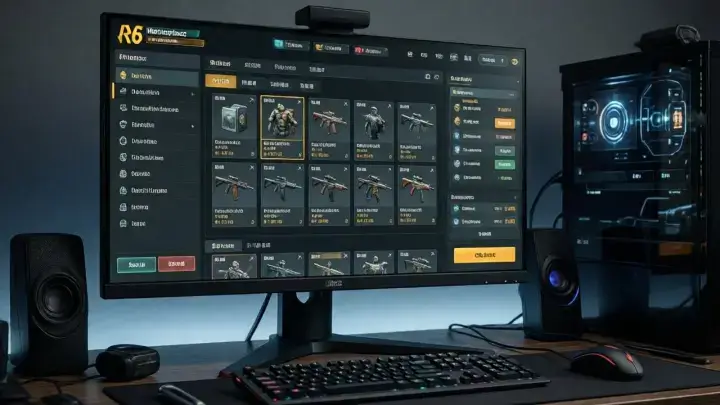
The R6 Marketplace changed an important part of Rainbow Six Siege: it turned cosmetic ownership into something that could move between players rather than remaining permanently locked to the account that first acquired an item. For a game built around tactical rounds, operators, maps, weapons, and competitive progression, the idea of a player-driven cosmetic economy introduced an entirely different layer of engagement.
Players could look for older weapon skins, decide what they were willing to pay, sell items they no longer wanted, and watch prices move according to demand. The system made certain cosmetics feel less like static rewards and more like digital collectibles.
But the story of the R6 Marketplace is not simply a story about buying and selling skins. Its development exposed some of the difficult questions surrounding virtual economies in modern multiplayer games. How much freedom should players have to trade digital items? What happens when rare cosmetics become expensive? Can a marketplace remain secure when valuable virtual goods are involved? And what should a publisher do when a trading system begins creating risks that extend beyond the cosmetics themselves?
Those questions became particularly important in 2026. Ubisoft announced that the Marketplace had been temporarily closed while it worked on stronger account security, fraud detection, and broader changes to the game’s economy. That development transformed the R6 Marketplace from a relatively straightforward trading feature into a case study in how complicated a player-driven digital economy can become.
Quick Bio
| Fact | Details |
|---|---|
| Subject | R6 Marketplace |
| Game | Tom Clancy’s Rainbow Six Siege |
| Publisher | Ubisoft |
| Primary purpose | Trading eligible Siege cosmetic items |
| Currency | R6 Credits |
| Trading model | Player-to-player marketplace orders |
| Marketplace fee | 10% of completed sale amount |
| Initial broader launch | Year 9 Season 2, 2024 |
| Access requirement at launch | Clearance Level 25 and two-factor authentication |
| Current status in 2026 | Temporarily closed |
| Main concerns behind closure | Account security, fraud, botting, credit transfers and economic balance |
What Is the R6 Marketplace?
The R6 Marketplace is Ubisoft’s official trading platform for eligible cosmetic items from Rainbow Six Siege. Rather than being another conventional store where Ubisoft simply sets a price for every item, the Marketplace was designed around player orders.
That distinction matters.
In a normal in-game shop, a developer decides that an item costs a particular number of credits. The player either accepts that price or walks away. A marketplace introduces another force: the players themselves. Sellers decide what they want to receive, while buyers decide the maximum amount they are willing to spend.
Ubisoft’s system allowed players to browse tradable items, place purchase orders, and offer their own eligible inventory items for sale. When compatible orders met, the transaction could be completed. A buyer’s stated amount functioned as a maximum rather than necessarily being the amount ultimately paid, because the Marketplace searched for the lowest matching sale.
That model gave Rainbow Six Siege something that conventional cosmetic stores usually do not have: a secondary economy.
The distinction between primary and secondary markets is useful here. When Ubisoft sells a cosmetic directly, the transaction introduces new content or currency into the game’s commercial ecosystem. When one player sells an already-owned item to another, the item is changing hands. The marketplace therefore creates a layer of economic activity around content that already exists.
This is one reason the R6 Marketplace became interesting even to players who were not serious traders. A person could suddenly look at an old skin differently. Something sitting unused in an inventory might have exchange value. A cosmetic that had been difficult to obtain might become attainable through another player rather than through the original acquisition method.
That changed the psychological relationship players could have with their collections.
How the Marketplace Came to Siege
The R6 Marketplace did not appear as an entirely mature system overnight. Its arrival followed experimentation and development around the idea of player trading.
Ubisoft had already spent years building a large cosmetic ecosystem around Rainbow Six Siege. Weapon skins, uniforms, headgear, charms and other customization items became an established part of the game’s identity. As the collection of cosmetic content expanded, so did interest in older and harder-to-find items.
The Marketplace became a response to that environment.
During Year 9, Ubisoft described the Siege Marketplace as a major feature and confirmed its full launch for Season 2 after a beta period.
That beta stage was important because a trading system affects more than the interface through which players buy things. It affects scarcity, pricing, player expectations and the perceived value of digital inventory.
When the broader Marketplace access arrived, Ubisoft required players to meet specific conditions. The initial public requirements included reaching Clearance Level 25 and enabling two-factor authentication. Ubisoft also tied access to account and in-game sanctions, reflecting the security-sensitive nature of the system.
The requirements made sense from a security perspective. A brand-new account with immediate access to a functioning player-to-player economy creates obvious opportunities for abuse. Requiring account progression and stronger authentication adds friction for bad actors while making the system less attractive to disposable accounts.
The Marketplace therefore arrived not simply as a shopping feature, but as a controlled economic environment.
Why the R6 Marketplace Became So Interesting
The appeal of the Marketplace came from scarcity.
Rainbow Six Siege has accumulated years of cosmetic content. Some items were tied to particular periods, seasons, events, collections or methods of acquisition. Once those circumstances changed, players could find themselves unable to obtain certain cosmetics through the ordinary store experience.
A marketplace changes that relationship.
Instead of asking only, “Is Ubisoft selling this item right now?” players could ask, “Does another player own it, and what would they accept for it?”
That is a fundamentally different question.
It also created an incentive to understand the market. A player who wanted one particular weapon skin could compare prices and decide whether to buy immediately or wait. Someone who wanted to sell could examine the existing market and determine whether their asking price was realistic.
The Marketplace consequently encouraged behaviors that resemble traditional collecting markets:
- Watching price movement
- Comparing scarce and common items
- Deciding when to buy
- Deciding when to sell
- Holding items for future use
- Clearing unwanted inventory
- Looking for older cosmetics
For a portion of the Siege community, that economic layer became part of the game’s appeal.
The competitive match remained the central experience, but the collection surrounding it gained another dimension.
The Mechanics Behind Buying
One of the most important details about the R6 Marketplace is that purchasing was based on orders rather than simply clicking a universal “Buy Now” button for every item.
A player could select a tradable item and specify the highest amount they were prepared to pay. The Marketplace then attempted to match that order with a seller.
This mechanism created an interesting separation between willingness to pay and actual purchase price.
Suppose a player was willing to spend 2,000 R6 Credits on a cosmetic. That did not automatically mean the player would pay exactly 2,000. According to Ubisoft’s Marketplace explanation, the stated price operated as a maximum, while the system searched for the lowest matching sale.
That makes the system closer to an order-driven market than a standard storefront.
It also explains why market prices could move.
If many players wanted an item but few owners wanted to sell, buyers could end up competing for limited supply. Conversely, if many players were willing to sell while demand remained modest, prices could move in the opposite direction.
The result was an economy that responded to player behavior rather than simply to a fixed publisher price.
Selling Unwanted Items
The other half of the system was selling.
Eligible items appeared in the Marketplace’s selling area, allowing owners to list cosmetics they no longer wanted. Not every item in a player’s inventory was necessarily tradable, however. Ubisoft explicitly noted that items missing from the Marketplace sell list were not currently available for trading.
That limitation is significant because players sometimes assume that a marketplace means unrestricted ownership transfers.
It did not.
The system operated within rules established by Ubisoft. Tradability depended on the item, its release status and the marketplace’s eligibility rules. For example, Ubisoft explained that items from the current season would not become tradable until the following season.
This approach helped prevent the market from immediately absorbing every newly released cosmetic.
There was also a direct financial consideration for sellers. Ubisoft retained a 10% transaction fee from completed sales.
That fee is important when thinking about marketplace economics because the amount a seller receives is not simply identical to the gross sale price. A player considering a listing therefore has to think about the final return rather than the headline number alone.
The Importance of R6 Credits
The R6 Marketplace operates around R6 Credits, the premium currency used within Rainbow Six Siege.
R6 Credits already had a broader role in the game. They can be used for things such as cosmetic items, Battle Pass-related purchases and other in-game content. Ubisoft continues to sell R6 Credit packs in several denominations.
This makes the Marketplace different from a cash marketplace where players directly exchange dollars or another real-world currency.
The player-facing economic unit is the R6 Credit.
That distinction matters because the value of an item is ultimately being expressed in a currency that already has an established relationship with the game’s commercial ecosystem.
It also creates an important boundary. The R6 Marketplace is not the same thing as selling a Rainbow Six Siege account for cash. Ubisoft has explicitly stated that buying, selling, sharing or trading accounts is not allowed under its Terms of Service.
That difference should not be overlooked.
Trading an eligible cosmetic through an official marketplace and transferring an entire account through an unofficial arrangement are fundamentally different activities.
The Difference Between the Marketplace and the Siege Store
The ordinary Siege store and the R6 Marketplace can look similar at first because both involve cosmetics and R6 Credits, but they serve different purposes.
The official store is controlled by Ubisoft. Ubisoft determines what is available and establishes the relevant purchase conditions.
The Marketplace, by contrast, was built around player-owned eligible items changing hands.
That creates different motivations.
Someone visiting the store may simply want the newest cosmetic. Someone visiting the Marketplace may be looking for an older item that is no longer directly available, or they may want to sell something already sitting in their inventory.
The distinction becomes especially important for collectors.
A store encourages consumption.
A marketplace encourages comparison.
One asks what Ubisoft is offering. The other asks what the community currently values.
That difference is part of what made the Marketplace feel significant within the wider Siege ecosystem.
The Collector’s Perspective
Cosmetics can seem superficial when viewed from outside a game.
For long-term players, however, they can carry memories.
A weapon skin might be associated with a favorite season. A charm might remind someone of an event. A particular cosmetic might have been obtained during an earlier period of the game that newer players never experienced.
That gives virtual items a form of personal history.
The R6 Marketplace added another layer because players could attach economic value to some of those objects. Scarcity and nostalgia could overlap.
A cosmetic did not have to be powerful to become desirable. It only needed to be distinctive, difficult to obtain, visually appealing, or connected to a period that players remembered.
This is one reason the broader concept of digital collecting has become increasingly important across multiplayer games.
For readers interested in the wider culture surrounding gaming communities, the gaming community perspective is useful because games increasingly function as social spaces rather than simply standalone products.
Why Prices Can Be Difficult to Understand
A common mistake when looking at a digital marketplace is assuming that an item’s price represents a permanent measure of its value.
It does not.
Market value is contextual.
A skin may be expensive because supply is low. Another may be inexpensive despite being old because large numbers of players own it. A cosmetic that becomes popular because of a content creator, community trend or renewed interest can experience changes in demand without its underlying design changing at all.
The reverse can happen too.
A once-popular item may lose attention.
This makes the R6 Marketplace inherently dynamic.
Price history and market graphs were among the improvements Ubisoft planned for the Marketplace experience, alongside item recommendations and other user-interface improvements.
Those features matter because a marketplace becomes much easier to navigate when users can understand context rather than seeing only one isolated number.
For an experienced trader, the question is rarely simply “How much does this cost?”
It is more likely to be:
How much does it usually cost, how frequently does it appear, and is the current price unusually high or low?
That is a much more sophisticated way to think about digital goods.
Security Became the Bigger Story
The most important chapter in the R6 Marketplace story is arguably the one that came after its initial success.
A player marketplace creates opportunities not only for legitimate trading but also for abuse.
If digital items have economic value, accounts containing those items become attractive targets.
Ubisoft’s 2026 communication about the Marketplace described problems involving account theft, botting and credit transfers, while also acknowledging broader economic issues such as pricing instability, distorted item circulation and imbalances within the game’s economy.
That combination is difficult to solve with a simple interface change.
Account theft is a security issue.
Botting is an automation issue.
Credit transfers can become an economic-control issue.
Pricing instability is a market-design issue.
The Marketplace therefore sits at the intersection of several systems that are normally easier to manage separately.
This helps explain why the decision to temporarily close it was more significant than simply taking a website offline for maintenance.
Ubisoft said the Marketplace would remain closed while improvements were made to account security, fraud detection and economy management. The company described the work as taking several months.
The closure consequently became part of the Marketplace’s identity.
What Happened to the R6 Marketplace in 2026?
As of 2026, the R6 Marketplace is temporarily closed.
That is an important distinction from saying that the feature has been permanently cancelled.
Ubisoft’s stated direction has been to work toward a safer and more balanced system rather than simply abandon the concept altogether. The company said that reintroducing the previous version without addressing its security and economic weaknesses would recreate the problems it had already identified.
This creates an unusual situation for players.
The original Marketplace demonstrated that there was demand for player-driven trading. At the same time, its problems demonstrated that demand alone does not make a marketplace sustainable.
The next version therefore has to solve a difficult equation:
How can player freedom be preserved without allowing the marketplace to become a source of account theft, manipulation, automation and economic instability?
That question will likely shape whatever comes next.
Why Account Security Matters So Much
In a conventional game, losing access to an account is already a serious problem.
In a game with a functioning player economy, the consequences can become even greater.
An account may contain a collection of cosmetics that the owner has accumulated over years. If those items can be traded or otherwise have economic significance, the account becomes more attractive to attackers.
This creates a feedback loop.
More valuable inventories can create stronger incentives to compromise accounts. More attacks create pressure for stronger authentication and monitoring. Stronger controls can then introduce additional friction for legitimate players.
The original Marketplace already required two-factor authentication for access when it became broadly available.
The fact that Ubisoft later identified account security as one of the major areas requiring further improvement illustrates how demanding the problem became.
A successful marketplace has to protect both the transaction and the account behind it.
The Problem With Bots
Automation is another challenge.
A human player can browse an item, consider a price and place an order. A bot can potentially monitor markets continuously, react in fractions of a second and repeat the same process at a scale that ordinary users cannot match.
That can distort a marketplace even when the underlying transactions appear legitimate.
Bots can change how quickly prices move, how inventory is captured and how easily ordinary players can participate.
This is not unique to gaming. Similar tensions appear in many online marketplaces whenever automated actors can monitor supply and demand more efficiently than individual users.
The R6 Marketplace’s experience shows why anti-bot systems are not simply technical extras. They are part of maintaining a credible economy.
If players believe that automated systems have an unfair advantage, confidence in the entire market can decline.
The Grey Market Around Siege
The official Marketplace also exists alongside an unofficial world of account trading and other transactions.
That distinction is critical.
Ubisoft has stated that buying, selling, sharing or trading accounts is prohibited. The company has also connected these practices with account theft and the broader cheating ecosystem.
A legitimate marketplace can actually help clarify the difference between authorized and unauthorized activity.
If players have an official mechanism for trading eligible items, there is less reason for them to seek unofficial arrangements for those particular transactions.
But that only works if the official system is trusted.
A marketplace must therefore be secure enough to compete with the convenience of informal channels without exposing users to unnecessary risks.
This is one reason the future of the R6 Marketplace matters beyond cosmetic collecting.
It is also about where Ubisoft wants economic activity around Siege to take place.
The Broader Digital-Collectibles Question
The R6 Marketplace belongs to a much larger trend in gaming: the increasing importance of virtual possessions.
Players spend years building collections.
Some cosmetics are common. Others become associated with particular eras of a game. Some disappear from ordinary circulation. Others remain widely available.
When a publisher introduces trading, these differences become visible through prices.
The result is not quite the same as owning a physical collectible.
A physical item can exist independently of the publisher’s servers. A Siege cosmetic depends on Ubisoft’s infrastructure, rules and account systems. Its availability can change, and its ability to be traded depends on the publisher’s decisions.
That makes digital ownership a more conditional form of ownership.
The R6 Marketplace brought that reality into sharp focus.
A player might think of a cosmetic as “mine,” but the practical rights surrounding that item are defined by the game’s systems and terms.
That is not necessarily a flaw. It is simply an important characteristic of digital games.
What the Marketplace Meant for Long-Term Players
For long-term Siege players, the Marketplace offered something that the regular store could not: a sense that their existing collection might have additional utility.
An unused cosmetic was no longer necessarily the end of a transaction.
It could potentially become part of another transaction.
That changes how players think about accumulation.
Instead of collecting only for personal use, some players may become more attentive to scarcity, desirability and timing. Others may simply appreciate the ability to clear out items they no longer care about.
The feature therefore appealed to different personalities for different reasons.
Collectors saw possibilities.
Casual players saw convenience.
Market watchers saw price movement.
Sellers saw a way to convert unwanted inventory into R6 Credits.
And Ubisoft saw a new economic layer that could make the broader cosmetic ecosystem more interactive.
The difficulty was making all of those interests coexist without creating incentives for abuse.
The Role of Community Attention
A marketplace also responds to community culture.
A cosmetic can become more noticeable because of a professional player, streamer, content creator or broader community trend. The more attention an item receives, the more likely players may be to seek it.
This creates a relationship between the competitive game, entertainment ecosystem and cosmetic economy.
A weapon skin is not necessarily valuable because of gameplay performance. It can become valuable because people want the identity associated with it.
That is a recurring feature of gaming cosmetics.
Players are not only buying pixels.
They are often buying association, nostalgia, rarity or personal expression.
For a game as established as Rainbow Six Siege, those cultural factors can be especially powerful.
Readers exploring the gaming world more broadly can see similar patterns across multiplayer communities, where cosmetic customization has gradually become part of a game’s social language.
What Could a Future Marketplace Look Like?
The future version of the R6 Marketplace will probably have to place security much closer to the center of the experience.
The old model proved that players were interested in trading. The next challenge is creating a system that can support that demand without reproducing the vulnerabilities Ubisoft identified.
Several principles appear particularly important.
Stronger Account Protection
Authentication and account recovery need to be robust because the value of a player’s inventory can increase the consequences of account compromise.
Better Fraud Detection
A modern marketplace needs systems capable of identifying suspicious patterns rather than simply reacting after a transaction has already caused damage.
More Careful Economic Controls
If certain items become excessively concentrated, prices become unstable or credit flows become distorted, the publisher may need mechanisms that protect the health of the wider economy.
Fair Access
Security systems should be strong without making legitimate players feel as though normal trading is unnecessarily difficult.
Transparency
Players are more likely to trust a marketplace when they understand its rules, fees, eligibility requirements and limitations.
These are not glamorous features, but they are the infrastructure required for a marketplace to survive.
What Players Should Remember About the R6 Marketplace
Anyone interested in the R6 Marketplace should separate three different ideas: the historical system, the current situation and unofficial alternatives.
Historically, the Marketplace allowed eligible players to trade certain cosmetics using R6 Credits.
Currently, Ubisoft has temporarily closed the Marketplace while it works on security, fraud and economic improvements.
Unofficial account-selling or account-trading arrangements are a separate matter and are not authorized simply because a player wants to transfer cosmetics or value.
That distinction is especially important for newer players who may encounter websites, social-media posts or private offers using the words “R6 Marketplace” loosely.
The safest way to understand the official system is to treat Ubisoft’s own Marketplace as the reference point rather than assuming every site or seller using similar terminology is connected to Ubisoft.
The Future of R6 Trading
The most interesting thing about the R6 Marketplace may ultimately be that it did not fail because players disliked trading.
The opposite appears closer to the truth.
The Marketplace demonstrated enough demand to make its economic and security problems consequential.
That creates a difficult but promising position for Ubisoft.
The company now knows that a player-driven market can add meaningful depth to Rainbow Six Siege. It also knows that simply restoring the previous system would not address the issues that emerged.
The next iteration therefore has an opportunity to be more deliberate.
It could retain the central attraction—letting players interact with a cosmetic economy—while introducing stronger protections against account theft, automation, fraudulent activity and unhealthy market behavior.
Whether that balance can be achieved will determine whether the R6 Marketplace becomes a lasting part of Siege’s future or remains primarily remembered as an ambitious experiment.
The history of Rainbow Six Siege provides useful context for understanding why the Marketplace matters: Siege has evolved substantially since its original release, and its longevity has depended partly on Ubisoft’s willingness to introduce systems that change how players interact with the game.
The Marketplace was one of those systems.
Why the R6 Marketplace Still Matters
The temporary closure does not erase what the Marketplace represented.
It showed that cosmetic collections could become more interactive. It gave players greater influence over the perceived value of digital items. It created a reason to pay attention to older inventory. It introduced a new economic conversation into a game already known for its competitive depth.
It also exposed the limits of player-driven economies.
A marketplace is never only a list of prices.
Behind every transaction are accounts, currencies, security systems, supply, demand, trust and rules. Once real economic incentives enter the picture, even cosmetic items can become targets for abuse.
That is the central lesson of the R6 Marketplace.
Its importance was never really about whether one particular skin cost 500 credits or 5,000. The larger story was about what happens when a long-running multiplayer game gives its community a structured way to assign value to digital possessions.
For Rainbow Six Siege, that experiment opened a new chapter.
The next chapter will depend on whether Ubisoft can rebuild the system with enough security and economic discipline to make trading sustainable. If it succeeds, the R6 Marketplace could return not merely as a store feature, but as a more mature component of the game’s long-term ecosystem.
If it does not, the Marketplace will remain an instructive example of how quickly a seemingly simple idea—letting players trade cosmetics—can evolve into one of the most technically and economically complicated systems surrounding a live-service game.
For now, its story is unfinished.
And that may be the most important thing to understand about the R6 Marketplace in 2026: it is not simply a marketplace that disappeared. It is a system being reconsidered because its first version revealed just how much was at stake.
Frequently Asked Questions About R6 Marketplace
1. What is the R6 Marketplace?
The R6 Marketplace is Ubisoft’s official player-driven trading platform for eligible Rainbow Six Siege cosmetic items. Players could use R6 Credits to buy and sell eligible items through marketplace orders rather than relying only on Ubisoft’s normal store.
2. Is the R6 Marketplace currently open?
No. As of 2026, Ubisoft has temporarily closed the Marketplace while working on improvements involving account security, fraud detection and management of the game’s economy.
3. What currency does the R6 Marketplace use?
The official Marketplace uses R6 Credits. R6 Credits are Ubisoft’s premium currency for Rainbow Six Siege and are also used for various other in-game purchases.
4. Can every Siege cosmetic be sold on the Marketplace?
No. Only items designated as tradable are eligible. Ubisoft has explained that some items, including certain recently released cosmetics, may not immediately be available for trading.
5. Did Ubisoft charge a fee for R6 Marketplace sales?
Yes. Under the original Marketplace system, Ubisoft retained a transaction fee equal to 10% of the completed sale amount.
6. Why was the R6 Marketplace closed?
Ubisoft cited several concerns, including account theft, botting, credit transfers, pricing instability, distorted item circulation and wider economic imbalances. The company said it was working on stronger security, fraud detection and economic-management systems before bringing the Marketplace back.
7. Is selling a Rainbow Six Siege account the same as using the Marketplace?
No. The official Marketplace was designed for eligible cosmetic-item transactions, while Ubisoft states that buying, selling, sharing or trading accounts is not allowed under its Terms of Service.
8. Will the R6 Marketplace return?
Ubisoft’s current communication describes the Marketplace as temporarily closed while improvements are developed rather than announcing a permanent cancellation. However, a specific reopening date should not be assumed until Ubisoft officially announces one.
A Marketplace Still Waiting for Its Next Chapter
The R6 Marketplace began with a relatively simple proposition: let players trade eligible Rainbow Six Siege cosmetics using the game’s own currency.
What emerged was far more complicated.
It connected collecting with economics, scarcity with demand, and digital ownership with account security. It gave players more control over their cosmetic collections while simultaneously creating new incentives for abuse. Its temporary closure in 2026 is therefore not merely a pause in a website’s availability. It represents a reassessment of how a major multiplayer game should manage a player-driven economy.
Whether the next version becomes safer, simpler and more sustainable remains to be seen.
But the experiment has already changed the conversation around what a Siege collection can mean—and what a modern live-service game must consider when its digital possessions start to behave like a real marketplace.
For More Visits: Dailymagazine