

 English































































RLP Letter: Meaning, Purpose, Legal Status and What to Do

What Is an RLP Letter? Meaning, Purpose, Legal Status, and What You Should Know
An RLP letter is commonly associated with Retail Loss Prevention Limited, a UK-based organization that provides civil recovery services to retailers and other businesses. People often search for this term after receiving a letter requesting payment following an alleged incident involving a shop, store, or retail business. The correspondence can be confusing, especially when it mentions financial liability, compensation, damages, or possible legal action.
Understanding an RLP letter begins with recognizing that it is generally connected to a civil recovery process rather than an automatic criminal punishment. A retailer may believe that an individual caused a financial loss and may ask an organization such as Retail Loss Prevention to communicate with that person about compensation. However, receiving a payment demand does not automatically establish that the allegation is correct or that the requested amount has been legally awarded.
The distinction between a private payment demand, a civil court claim, and a criminal proceeding is particularly important. Each involves a different process and can have different consequences. Readers should also understand that RLP is an abbreviation that may have other meanings in unrelated industries, although the retail loss prevention meaning is the most relevant interpretation of the phrase in UK consumer-related searches.
This guide explains what an RLP letter is, why someone might receive one, what information it can contain, how civil recovery works, and what people should consider before responding.
What Does RLP Stand For?
In the UK retail context, RLP stands for Retail Loss Prevention. Retail Loss Prevention Limited provides services to businesses dealing with alleged losses arising from incidents involving their property or operations.
Retailers may use civil recovery services when they believe an incident has resulted in financial losses. Rather than handling every communication themselves, a business may use an external organization to manage correspondence and pursue a civil compensation claim.
An RLP letter is therefore generally a communication connected with a retailer’s claim. It may explain the incident being referred to, identify the business involved, describe the alleged loss, and request payment.
It is important to understand that the abbreviation does not describe one universal legal document. Other organizations may use RLP to mean something different. The full sender name and the contents of the correspondence should always be checked before deciding what a particular letter means.
What Is Retail Loss Prevention Limited?
Retail Loss Prevention Limited is associated with civil recovery services for businesses in the United Kingdom. Its role in a retail-related matter is generally to communicate with individuals on behalf of a business that believes it has suffered a loss.
This distinction matters because the retailer is generally the party asserting the underlying claim. RLP acts in connection with the retailer’s recovery process; the existence of its letter does not mean that a court has independently confirmed the allegations.
For readers, the most useful starting point is to identify the organization named on the document and understand which retailer is involved.
What Is the Purpose of an RLP Letter?
The main purpose of an RLP letter is to communicate a civil recovery claim or payment request connected with an alleged retail incident.
A retailer may believe that an individual has caused a loss through an incident involving merchandise, property, or business operations. The retailer may then refer the matter to a recovery service to communicate with the person concerned.
The letter can serve several purposes:
- Explain why the individual is being contacted.
- Identify the retailer or business involved.
- Describe the alleged incident.
- Explain the basis of the requested compensation.
- State the amount being claimed.
- Provide information about available response or payment options.
- Explain what may happen if the matter remains unresolved.
The exact information depends on the circumstances and the correspondence issued.
An important point is that a payment request represents a claim being made. It should not automatically be interpreted as proof that the recipient owes the amount stated.
Why Might Someone Receive an RLP Letter?
People commonly associate RLP letters with allegations involving shoplifting or retail theft. However, civil recovery claims can concern different types of alleged incidents that a business believes caused financial damage.
The circumstances described in the letter should be examined individually.
1. Alleged Shoplifting
One common reason for receiving an RLP letter is an allegation of shoplifting.
A retailer may believe that merchandise was taken without payment. If the business decides to pursue compensation through a civil recovery process, correspondence may be sent to the person it believes was involved.
The letter may identify the store, date, location, and circumstances of the alleged incident.
However, an allegation and a proven legal finding are different things. The recipient should examine the details rather than assuming that every statement in the letter has already been established.
2. Alleged Retail Theft
Retail theft can involve more than one type of incident. A retailer may refer a matter for recovery when it believes that goods or other business property have been taken or lost because of someone’s actions.
The precise nature of the allegation should be stated in the correspondence.
3. Alleged Employee Theft or Misconduct
Some businesses may pursue civil compensation where they believe an employee has caused financial loss through theft or other misconduct.
This is different from an ordinary customer-related retail incident because employment arrangements and additional legal considerations may be involved.
A recipient facing an allegation connected with their employment may need advice that considers both employment law and civil liability.
4. Damage to Retail Property
A business may also believe that someone has damaged merchandise, equipment, or other property.
If the business claims that the incident caused a financial loss, it may consider pursuing compensation.
Whether a particular amount is recoverable depends on the evidence, the circumstances, and the applicable legal principles.
What Information Does an RLP Letter Usually Contain?
An RLP letter may contain several details intended to explain the claim and identify the matter.
Although the format can vary, recipients should look for the following information:
| Information | Why It Matters |
|---|---|
| Sender’s name | Identifies the organization contacting you |
| Retailer’s name | Shows which business is involved |
| Reference number | Helps identify the specific case |
| Incident date | Identifies when the alleged event occurred |
| Incident location | Identifies the store or business location |
| Description of allegation | Explains what the retailer believes happened |
| Amount requested | Shows the compensation being claimed |
| Payment instructions | Explains the proposed payment method |
| Response information | Explains how to communicate with the sender |
| Deadline | Identifies any requested response date |
Not every letter will contain exactly the same information. The recipient should read the entire document, including any additional pages or explanatory materials.
Why Is the Reference Number Important?
A reference number helps the sender identify the relevant matter. It may be needed when contacting the organization, requesting clarification, or discussing the correspondence.
Keeping the reference number with a copy of the letter can make future communication easier.
Recipients should avoid publishing reference numbers, personal details, or sensitive information in public online discussions.
Is an RLP Letter a Fine or a Court Judgment?
No. An RLP payment demand should not automatically be confused with a criminal fine or a court judgment.
This is one of the most important distinctions for anyone researching the subject.
A private organization may communicate a business’s compensation claim without a court having decided whether the recipient is legally liable.
A court judgment, on the other hand, is a formal decision made through a legal process.
The two situations are different.
| Document or process | General meaning |
|---|---|
| RLP payment demand | A communication requesting compensation |
| Civil claim | A legal claim seeking a remedy through civil proceedings |
| Criminal fine | A financial punishment imposed through criminal proceedings |
| County Court Judgment (CCJ) | A formal court judgment concerning a debt or money claim |
According to GOV.UK, a County Court Judgment is issued when a court formally decides that money is owed. GOV.UK+1
Receiving an initial RLP letter does not itself create a CCJ.
However, this does not mean that every RLP-related matter can be ignored. If a business takes formal court action, the recipient must understand the legal documents and follow the applicable response procedure.
Understanding Civil Recovery in Retail
Civil recovery is a process through which a business seeks compensation for a loss it believes another person caused.
In retail situations, a business may argue that an incident resulted in financial damage and that the person involved should compensate it.
Civil recovery and criminal proceedings are separate legal processes.
A business may consider civil action even when a criminal prosecution has not taken place. In some circumstances, civil and criminal processes may also exist alongside one another.
Citizens Advice explains that businesses can pursue civil compensation following allegations such as shoplifting or employee theft. It also explains that recipients may have options when they receive a demand for payment. Citizens Advice
What Is the Difference Between Civil and Criminal Proceedings?
Civil proceedings generally concern disputes between individuals or organizations, including claims for compensation.
Criminal proceedings concern alleged offences dealt with through the criminal justice system.
For example:
- A retailer seeking compensation for an alleged financial loss is pursuing a civil matter.
- A criminal prosecution concerning alleged theft is a separate process.
- A court judgment concerning a civil money claim is not the same as a criminal conviction.
Understanding this difference helps prevent confusion when reading formal correspondence.
What Should You Do After Receiving an RLP Letter?
Receiving an unexpected payment demand can be stressful. However, making an immediate decision without understanding the document is not advisable.
A careful review can help establish what the sender is claiming and what action may be appropriate.
1. Check the Sender’s Identity
Start by checking the full name of the organization that sent the correspondence.
If the letter claims to come from Retail Loss Prevention Limited, verify its contact details independently rather than relying entirely on information in an unexpected email or message.
Be cautious about sharing identification documents, banking information, or other sensitive personal details before confirming who is requesting them.
2. Read the Allegation Carefully
Identify what the retailer says happened.
Look for the date, location, description of the incident, and the name of the business involved.
If any information appears incorrect, keep a record of the discrepancy.
3. Examine the Amount Being Claimed
Read how the requested amount is explained.
Do not assume that the figure is automatically correct simply because it appears in formal correspondence.
If the calculation is unclear, consider requesting an explanation and supporting information.
4. Preserve Relevant Documents
Keep the original letter, envelopes, emails, receipts, and other relevant records.
If there are documents or messages that may help explain the incident, preserve them rather than deleting them.
A clear record can be useful if the matter is disputed or professional advice is needed.
5. Check Any Deadlines
Look carefully for dates by which the sender requests a response.
A private payment demand and a formal court claim have different legal significance, but neither should be handled carelessly.
If you receive an actual court claim, follow its instructions and deadlines. GOV.UK explains the available ways to respond to money claims, including paying, admitting part of a claim, or defending it. GOV.UK+1
6. Seek Appropriate Legal Advice
If you disagree with the allegation, question the amount, or are concerned about possible court proceedings, consider obtaining advice from a qualified legal professional.
The relevant law can depend on where the incident occurred. UK procedures are not identical across England, Wales, Scotland, and Northern Ireland.
Can You Dispute an RLP Letter?
A recipient may have grounds to dispute a payment demand, depending on the facts and applicable law.
Disagreement can relate to the incident itself, the identity of the person involved, the evidence, the claimed financial loss, or the amount requested.
For example, a recipient might believe that the date is incorrect or that the business has misunderstood what happened.
A dispute should be based on the actual circumstances rather than a general assumption that every recovery demand is invalid.
What Information Might Be Relevant to a Dispute?
Depending on the situation, useful information may include:
- Receipts or proof of payment.
- Records showing where the individual was at the relevant time.
- Relevant correspondence.
- Details of witnesses.
- Documents relating to the alleged loss.
- An explanation of why the requested amount is disputed.
The purpose is to understand the claim and identify the specific points that require clarification.
Citizens Advice recommends considering the strength of the evidence and whether the claimed losses are reasonable when assessing a business’s demand for compensation. Citizens Advice
What Happens If You Ignore an RLP Letter?
Ignoring correspondence is not necessarily a safe way to resolve a dispute.
A business may decide to send further communications or consider formal legal proceedings. Whether it actually does so depends on the individual circumstances.
It is important to distinguish between ignoring a private demand and failing to respond to a formal court claim.
If a court claim is issued, the recipient must follow the court’s instructions. GOV.UK explains that failing to respond to a money claim can result in the claimant seeking a County Court Judgment. GOV.UK+1
A CCJ can have consequences for a person’s financial circumstances and credit record.
Therefore, someone who receives genuine court documents should not treat them as ordinary reminder letters.
Does an RLP Letter Affect Your Criminal Record?
An initial civil recovery demand is not itself a criminal conviction.
A private payment request does not mean that a court has found someone guilty of an offence.
However, the underlying incident may involve a separate criminal investigation or prosecution, depending on the circumstances.
Readers should not assume that receiving an RLP letter automatically creates a criminal record, nor should they assume that civil correspondence rules out separate criminal proceedings.
The distinction between the two processes is essential.
Does an RLP Letter Affect Your Credit Score?
An initial payment demand is not the same as a County Court Judgment.
The important issue is whether the matter progresses into formal court proceedings and whether a judgment is subsequently recorded.
GOV.UK explains that County Court Judgments are recorded and can affect a person’s ability to obtain credit. It also explains the circumstances in which a judgment can be removed from the register. GOV.UK
For this reason, readers should avoid making broad assumptions about credit consequences based only on receiving an RLP letter.
Is an RLP Letter Genuine?
A genuine RLP letter should be identifiable through its sender, contact information, reference details, and explanation of the matter.
However, the appearance of a document alone cannot prove that it is genuine.
If you receive unexpected correspondence:
- Check the organization’s full name.
- Verify contact information independently.
- Check whether the reference details match the correspondence.
- Be cautious about unusual payment requests.
- Avoid sending sensitive information until the sender has been verified.
This is a sensible precaution with any unexpected legal or financial communication.
RLP Letter and UK Consumer Rights
People who receive retail recovery correspondence may want to understand their rights and responsibilities.
The legal position depends on the specific facts, the evidence, and the relevant jurisdiction.
A business seeking compensation must have a legal basis for its claim. The amount requested should also be considered in light of the circumstances.
The recipient may need to decide whether to accept the claim, dispute it, request more information, or seek professional advice.
Citizens Advice provides guidance for people accused of causing financial losses to a business, including situations involving shoplifting and employee theft. Citizens Advice
For England and Wales, the Civil Procedure Rules also describe general expectations around pre-action correspondence, including providing details of a claim and giving the other party an opportunity to respond. Justice UK
These rules should not be confused with a guarantee that every individual RLP letter follows the same procedure.
Common Misunderstandings About RLP Letters
Several misconceptions can make this subject more confusing than necessary.
An RLP letter is always a criminal fine. This is incorrect. Retail-related RLP correspondence is generally associated with civil recovery.
Receiving a letter means a court has found you liable. This is incorrect. A private payment demand is not a court judgment.
Every RLP letter has the same meaning. The abbreviation can be used in different industries, although Retail Loss Prevention is the relevant meaning in the common UK retail context.
The requested amount must always be paid immediately. The legal basis and circumstances of the claim need to be considered.
Ignoring every letter is harmless. This is also incorrect. Formal court proceedings have separate deadlines and consequences.
Understanding these distinctions helps readers approach the matter more carefully.
Frequently Asked Questions About RLP Letters
1. What does RLP stand for?
In the UK retail context, RLP stands for Retail Loss Prevention. It is associated with civil recovery services for businesses.
2. Why have I received an RLP letter?
You may have received one because a retailer believes an incident caused a financial loss and is seeking compensation. The specific reason should be explained in the letter.
3. Is an RLP letter a court document?
Not necessarily. An initial RLP payment demand is generally private correspondence. A formal court claim is a separate legal document.
4. Is RLP a government organization?
Retail Loss Prevention Limited is a private company, not a government court or criminal authority.
5. Can an RLP letter lead to court action?
A business may consider civil court proceedings if a claim remains unresolved. Whether proceedings are started depends on the individual circumstances.
6. Does receiving an RLP letter mean I have a criminal record?
No. Receiving a private civil recovery demand does not itself create a criminal conviction or criminal record.
7. Can I challenge the amount requested?
You may dispute a claim or request clarification where you have a genuine reason to question the alleged loss or the amount being sought. The outcome depends on the evidence and applicable law.
8. Should I ignore an RLP letter?
Ignoring it is not a reliable way to resolve the matter. Read the correspondence, identify any deadlines, and consider appropriate advice.
9. What is the difference between an RLP demand and a CCJ?
An RLP demand is a request for compensation. A CCJ is a formal judgment issued by a court after a money claim reaches the relevant stage.
10. Where can I find reliable information about an RLP letter?
Useful starting points include Retail Loss Prevention’s official information, Citizens Advice, GOV.UK, and the Civil Procedure Rules.
Conclusion: Understanding an RLP Letter Before Taking Action
An RLP letter is generally associated with Retail Loss Prevention and civil recovery claims made on behalf of UK retailers. It may be sent when a business believes an incident has caused financial loss and seeks compensation from the person it considers responsible.
The most important distinction is that a payment demand is not automatically a criminal fine or a court judgment. It communicates a claim, but the legal basis and supporting evidence still matter.
Anyone receiving this type of correspondence should identify the sender, read the allegation carefully, examine the requested amount, preserve relevant documents, and pay attention to deadlines. If the claim is disputed or formal proceedings are mentioned, appropriate legal advice can help clarify the available options.
Understanding the difference between private recovery correspondence and formal legal proceedings makes it easier to assess an RLP letter without unnecessary assumptions or confusion.
G. Relevant Image Alt Text
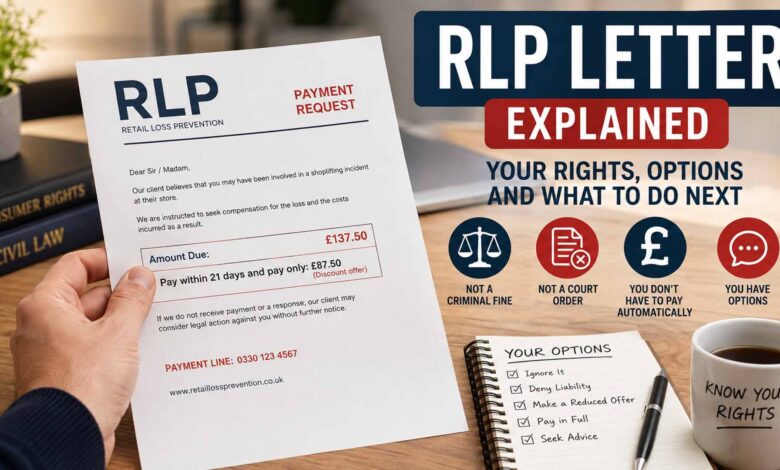
Image Alt Text: RLP Letter from Retail Loss Prevention explaining a retail civil recovery payment demand.
Suggested Featured Image: A formal business letter on a desk with a retail shopping bag, documents, and a pen, representing Retail Loss Prevention and civil recovery correspondence.
H. Fact-Checking Notes
| Important claim | Status |
|---|---|
| RLP stands for Retail Loss Prevention in the UK retail context | Verified |
| RLP correspondence can concern civil recovery claims | Verified |
| An initial payment demand is not automatically a court judgment | Verified |
| A business can pursue civil compensation for alleged retail losses | Verified |
| A CCJ can affect credit records | Verified |
| Every RLP letter follows an identical procedure | Not established |
| Every requested recovery amount is legally enforceable | Not established |
Reliable research sources:
- Citizens Advice – A business takes legal action against you to recover losses for theft.
- GOV.UK – Respond to a court claim for money.
- GOV.UK – County Court Judgments for debt.
- Justice UK – Practice Direction on Pre-Action Conduct.
- GOV.UK – Respond to a claim by post.
Editorial note: The article focuses on the UK retail meaning of RLP. It is general information, not individual legal advice. The applicable rules may differ in Scotland, Northern Ireland, and other jurisdictions.
WordPress recommendation: Use the category Law & Legal Information, with the primary keyword RLP Letter.
For More Visit “ dailymagazine.blog